
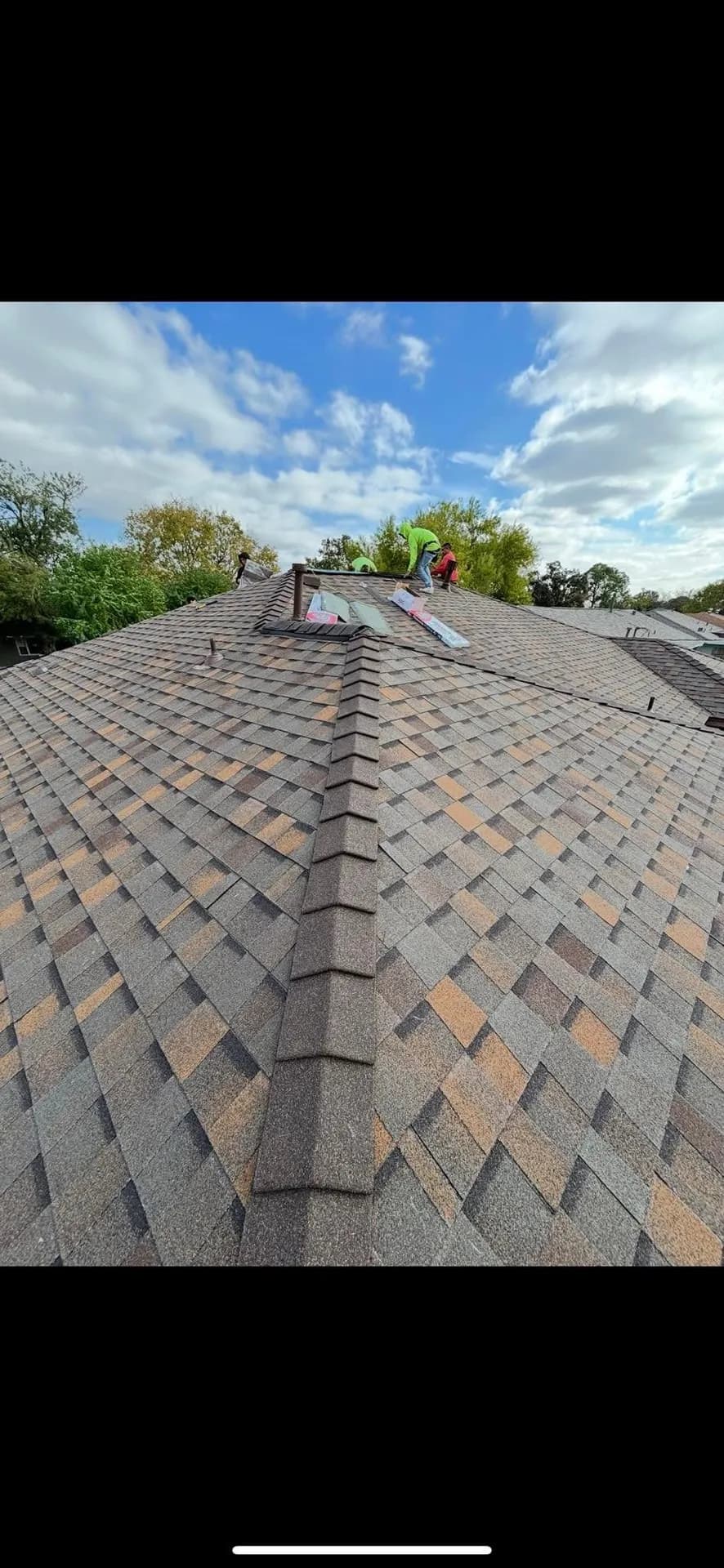
Roofing
Wind Damage Roof Repair
Wind Damage Roof Repair in The Woodlands and Magnolia
What's Included
Wind Damage Roof Repair in The Woodlands, TX
Edges and Ridges First
Uplift is highest at the perimeter and the ridge, so that is where we start. A roof can look perfect across the field and have a compromised first course all the way around.
Creased Shingles Count
A shingle that lifted and folded back on itself is damaged even after it lies flat again. The crease is a fracture line in the mat. We look for those rather than only for missing shingles.
Broken Seal Strips
Asphalt shingles rely on a heat-activated adhesive strip to stay bonded. Once wind breaks that bond the shingle will lift again in the next storm at a lower wind speed than it took the first time.
Ridge Caps and Flashing
Ridge caps and drip edge take wind before anything else does. Missing caps expose the ridge vent and the cut in the decking underneath, which is a direct path into the attic.
Documented for Your Own Claim
Wind claims turn on where the damage is and what it looks like. We photograph the creases, the lifted courses, and the missing caps, and give you a written estimate for your own use.
Repairs That Match
Replacing wind-blown shingles on a roof that has aged in Texas sun means matching a weathered color, not a new one. We tell you honestly when a repair will be visible.
How Wind Actually Damages a Roof
People picture wind damage as shingles flying off, and sometimes it is. More often it is subtler and more expensive to ignore.
Wind moving over a roof creates lift, in much the same way it does over a wing. That lift is not evenly distributed. It is strongest at the perimeter of the roof and along the ridge, which is why damage concentrates in a band around the edges and along the top rather than in the middle of a slope. A gust gets under the leading edge of a shingle, lifts it, and either tears it away or drops it back down.
The shingles that get dropped back down are the ones that cause trouble later. An asphalt shingle is held not just by nails but by a strip of heat-activated adhesive that bonds it to the course below. Once wind breaks that bond, it does not re-form. The shingle lies flat and looks normal from the ground, but it is no longer sealed, and the next storm lifts it at a lower wind speed than the first one needed. A roof can accumulate a lot of unsealed shingles before anything visibly fails.
The other signature is creasing. A shingle that folds back on itself and returns leaves a horizontal line across the mat. That crease is a fracture. It will leak eventually whether or not the shingle is still in place, and it is one of the main things an experienced inspector is looking for after a wind event.
Where We Look
Because wind damage follows the pressure zones rather than being random, an inspection has a shape to it.
The Ridge and Ridge Caps
Ridge caps are individual shingles bent over the peak, fastened at the most exposed line on the roof. They go first. When they go, whatever is under them is exposed, and if the ridge is vented that means a continuous slot cut through the decking with nothing over it. Missing ridge caps after a windstorm are not cosmetic and should not wait.
Rakes and Eaves
The rake is the sloped edge at a gable end and the eave is the horizontal edge at the bottom. Both are perimeter, both see the highest uplift, and both rely on drip edge metal that can peel back and take the first shingle course with it. We check the first two or three courses in from every edge.
The Ground
What is in the yard tells you something before anyone gets on the roof. Whole shingles or pieces of them, ridge cap fragments, and unusual amounts of granules at the bottom of downspouts all indicate the roof gave up material. So does a section of drip edge or fascia trim lying in the flower bed.
Wind, Hail, and Your Deductible in Texas
Texas policies handle wind differently from the way many other states do, and the difference is worth knowing before you decide how to proceed.
According to the Insurance Information Institute, in Texas the windstorm deductible applies to windstorm and hail damage from any type of wind storm, not only to named storms or hurricanes. In a number of coastal states a percentage deductible only kicks in when the National Weather Service declares a hurricane or tropical storm. Here, an ordinary spring thunderstorm with a strong gust front can fall under the same deductible structure as a named system.
Those deductibles are usually written as a percentage of the insured value of the dwelling rather than as a flat amount, and the Insurance Information Institute puts the typical range between one and five percent. The percentage applies to your dwelling coverage limit, not to the size of the loss, which is the detail that catches most homeowners off guard. A moderate wind claim can sit entirely underneath the deductible on a well-insured house.
Knowing that number before you file is worth the five minutes it takes to find it on your declarations page. We document what we find and provide a written estimate for your own use. We do not advise you on whether to file, we do not negotiate with your carrier, and we bill your deductible as your policy writes it. Our roof insurance claim documentation page explains exactly where that line sits under Texas law.
Repair, or Replace
Wind damage is often genuinely repairable, more so than hail, because it tends to be concentrated rather than spread across the whole surface.
A repair makes sense when the damage is confined to an edge or a ridge run, the rest of the field is sealed and sound, and the roof has service life left. Replacing a section of ridge caps and the first two courses along a rake is a normal, proportionate fix.
Two things push toward replacement. The first is scale: once shingles are unsealed across multiple slopes, you are no longer repairing a spot, you are dealing with a roof that will keep shedding material every time it blows. The second is age. Matching a fifteen year old weathered shingle is difficult, and on a roof near the end of its life a patched section tends to be the visible start of a larger job you will do soon anyway.
If shingles are off and water is getting in now, treat it as an emergency roof repair rather than waiting, and emergency roof tarping will keep the weather out until the permanent repair can be done properly. If wind arrived with hail, which it frequently does here, the hail damage and general storm damage pages cover the other half of that.
Working in This Part of Texas
The counties north of Houston sit far enough inland to avoid the worst of a landfalling storm surge and close enough to take the wind. Tropical systems arrive here with their circulation still organized, and the roofs that suffer are usually the ones that had already lost their seal in an earlier, less memorable storm.
That is the argument for looking at a roof after a wind event even when nothing obvious happened. Unsealed shingles are cheap to address and expensive to discover during the next system.
ROYH Build Co is licensed and insured, GAF Certified Plus and Atlas Platinum certified, and works across Montgomery County and Harris County from The Woodlands and Magnolia. Our LumaNail luminescent nails and Catch-All perimeter debris system mean a wind repair does not leave fasteners in the grass.
Related Services
More Roofing Services
Roof Repair
Learn moreEmergency Roof Repair
Learn moreRoof Replacement
Learn moreNew Roof Installation
Learn moreRoof Inspection
Learn moreStorm Damage Roof Repair
Learn moreRoof Ventilation Installation
Learn moreSolar Attic Fan Installation
Learn moreRoof Leak Repair
Learn moreHail Damage Roof Repair
Learn moreRoof Insurance Claim Documentation
Learn moreRoof Replacement Cost
Learn moreHail Damage Roof Inspection
Learn moreEmergency Roof Tarping
Learn moreRoof Decking Repair
Learn moreSynthetic Shingle Roofing
Learn moreGet Your Free Wind Damage Roof Repair Estimate
Serving The Woodlands, Magnolia, and the greater Houston area, ROYH Build Co will assess your wind damage roof repair needs and give you a straightforward recommendation.
Frequently Asked Questions
How much wind does it take to damage a roof?
Less than most people expect, and it depends on the roof rather than a single number. An older roof whose shingle seals have already weakened can lose material in gusts well below what a new roof in good condition would shrug off. Age, previous storms, and installation quality matter more than the wind speed alone.
My shingles look fine but I lost a few. Is the rest of the roof okay?
Not necessarily. The concern after a wind event is not only what came off but what lifted and set back down. Those shingles have broken their adhesive seal and will lift again more easily next time, and they look normal from the ground. That is why the edges and ridge get inspected up close.
What is a creased shingle?
It is a shingle that folded back on itself in the wind and then returned to position, leaving a horizontal fracture line across the mat. It is damage even though the shingle is still attached, because the crease will eventually let water through and the shingle cannot be resealed.
Does my policy treat wind differently from other damage?
In Texas it commonly does. The Insurance Information Institute notes that the Texas windstorm deductible applies to wind and hail damage from any windstorm, not only named storms, and these deductibles are typically a percentage of your dwelling coverage limit rather than a flat amount. Check your declarations page for your figure.
Will a repair match the rest of my roof?
On a newer roof, usually closely. On a roof that has weathered a decade or more of Texas sun the new shingles will be a shade off, because the existing ones have faded. We will tell you before the work whether a repair is going to be visible so you can decide.