
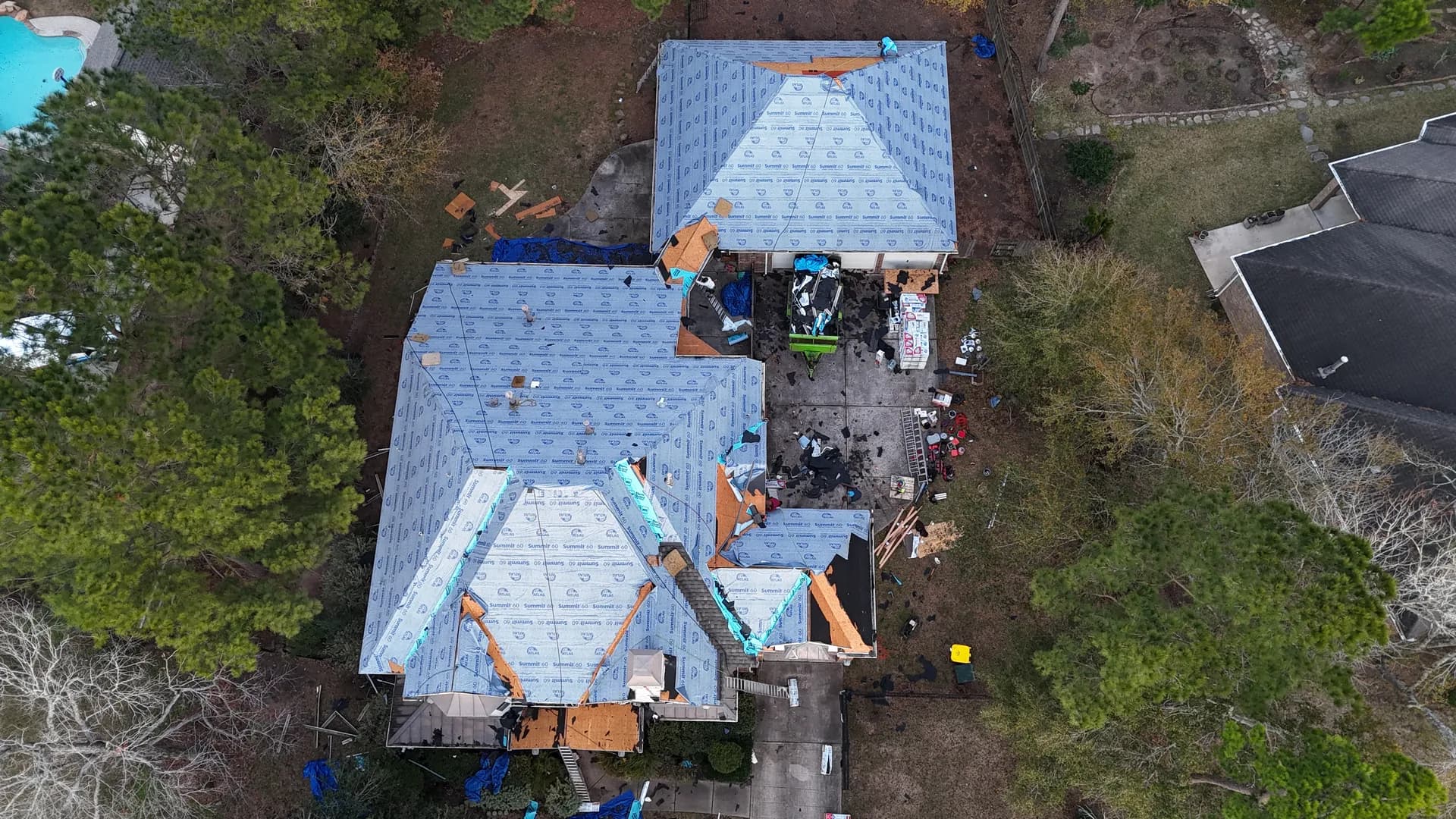
Roofing
Emergency Roof Tarping in The Woodlands
Emergency Roof Tarping in The Woodlands and Magnolia
What's Included
Emergency Roof Tarping in The Woodlands, TX
Stops the Water, Buys the Time
The point is to get your house dry today so the permanent repair can be scoped, ordered, and scheduled properly instead of rushed.
Fastened to Hold, Not Just Laid Down
A tarp weighted with bricks is gone in the next gust. Ours are wrapped and fastened at the edges so they survive the weather that follows the storm.
Run Over the Ridge Where Needed
Water driven uphill by wind goes under a tarp that stops short of the peak. Where the damage is near a ridge, the tarp goes over it.
Damage Documented While Exposed
Before we cover anything we photograph what is underneath. Once a tarp is on, that evidence is hidden, and it may matter to your claim.
A Temporary Measure, Described Honestly
Tarps last weeks, not seasons. We will tell you roughly how long yours should hold and what the permanent fix involves.
Minimal New Penetrations
Fastening a tarp means putting holes in a roof. We place them where the permanent repair will cover them rather than anywhere convenient.
What a Tarp Is Actually For
There is a specific situation a tarp solves, and it is worth being precise about it, because tarping gets sold as though it were a repair and it is not one.
After a storm takes shingles off, your roof has an opening. The permanent fix requires matching material, a crew, dry weather, and often an insurance conversation, and none of those things happen the same afternoon. Meanwhile the forecast does not care. A tarp closes the gap between those two timelines. It gets your house dry today so the real repair can be scoped properly rather than rushed with whatever is on the truck.
Framed that way, the value of a tarp is not the tarp. It is that a dry house does not accumulate the secondary damage that turns a roofing job into a drywall, insulation, flooring, and mold job. In this climate that escalation is fast. Wet insulation in a Gulf Coast attic does not dry out in air that is already saturated.
Doing It Properly
Most failed tarps fail for the same handful of reasons, and they are all avoidable.
It Has to Be Fastened
A tarp held down by bricks, tires, or sandbags is a sail. The weather that follows a storm is frequently still windy, and an unfastened tarp is often gone before the next rain, usually overnight and usually without anyone noticing until water comes through again.
Fastening properly means wrapping the tarp edges around furring strips and screwing through the assembly into the deck, so the load is spread along a board instead of tearing through grommets. It is more work on the day and it is the difference between a cover that lasts and one that does not.
It Has to Go Over the Ridge
Where damage is near the peak, a tarp that stops below the ridge will leak, because wind-driven rain moves water uphill and straight under the top edge. Running the tarp over the ridge and down the opposite slope means water crossing the peak lands on top of the tarp rather than under it. This is the single most common reason a professionally installed tarp still leaks.
Penetrations Get Placed Deliberately
There is no way to fasten a tarp without putting holes in a roof, and anyone claiming otherwise is either using weights or not being straight with you. What a careful crew does is place those fasteners where the permanent repair will remove or cover them, so the temporary measure does not create a new problem after it comes off.
Document Before You Cover
This is the step most often skipped and it is worth insisting on.
The moment a tarp goes on, the damage underneath is hidden. If an insurance claim follows, the adjuster arrives to a blue sheet and has to take someone's word for what is beneath it. Photographs taken before the tarp went down, showing the missing shingles, the exposed decking, and the extent of it, are worth considerably more than a description after the fact. The Texas Department of Insurance makes the same general point about storm damage: document it before any work starts.
We photograph what is there before we cover it, and you get those images. Our roof insurance claim documentation page explains what we can and cannot properly do on a claim in Texas, and hail damage roof inspection covers the fuller assessment once conditions allow.
How Long a Tarp Lasts, Honestly
Weeks. Not a season, and certainly not a year.
A properly fastened tarp will typically hold through the weeks it takes to get materials, schedule a crew, and complete an insurance conversation. Beyond that, ultraviolet light degrades the polyethylene, the material grows brittle, and the fasteners work at the edges. A tarp that has been up for months is usually leaking somewhere and hiding the fact that the deck underneath has been damp the whole time.
If a permanent repair is going to be delayed well beyond that, the right answer is usually a proper temporary dry-in with underlayment rather than a longer-lived tarp, and we will tell you when that is the case.
The permanent fix itself depends on the damage: wind damage roof repair if shingles were lifted or torn off, hail damage roof repair if the surface was bruised, or roof replacement where the damage is widespread.
When to Call, and What to Do First
Call when the roof is open. Missing shingles over living space, exposed decking visible from the ground, a section of ridge gone, or active water coming into the house all qualify.
Before anyone arrives, move what is under the leak and put a container down. If a ceiling is bulging it is holding water, and draining it at the low point into a bucket is better than waiting for it to give way. Photograph everything, including the date. Do not go on the roof yourself: it is wet, and the part that failed is the part you would be standing on.
Our hours are Monday through Saturday, and our emergency roof repair page covers the wider response. If water is coming in but the roof is intact, roof leak repair is more likely what you need, since the entry point is rarely above the stain.
ROYH Build Co is licensed and insured and works across Montgomery County and Harris County from The Woodlands and Magnolia. Our LumaNail luminescent nails and Catch-All perimeter system mean the debris that came off your roof leaves with us rather than staying in the yard.
Related Services
More Roofing Services
Roof Repair
Learn moreEmergency Roof Repair
Learn moreRoof Replacement
Learn moreNew Roof Installation
Learn moreRoof Inspection
Learn moreStorm Damage Roof Repair
Learn moreRoof Ventilation Installation
Learn moreSolar Attic Fan Installation
Learn moreRoof Leak Repair
Learn moreHail Damage Roof Repair
Learn moreWind Damage Roof Repair
Learn moreRoof Insurance Claim Documentation
Learn moreRoof Replacement Cost
Learn moreHail Damage Roof Inspection
Learn moreRoof Decking Repair
Learn moreSynthetic Shingle Roofing
Learn moreGet Your Free Emergency Roof Tarping Estimate
Serving The Woodlands, Magnolia, and the greater Houston area, ROYH Build Co will assess your emergency roof tarping needs and give you a straightforward recommendation.
Frequently Asked Questions
How long will a roof tarp last?
Weeks rather than months. A properly fastened tarp will normally hold through the time it takes to order materials, schedule a crew, and work through an insurance conversation. Ultraviolet light degrades the material after that, and the fasteners begin working loose at the edges.
Does tarping put holes in my roof?
Yes, and any honest answer says so. Fastening is what keeps a tarp on in the wind that usually follows a storm, and weighting it with bricks or sandbags does not. What matters is that the fasteners are placed where the permanent repair will cover or remove them.
Should I photograph the damage before it gets tarped?
Yes, and we do it as part of the job. Once a tarp is on, the damage underneath is hidden from anyone who looks later, including an adjuster. Images showing the missing shingles and exposed decking before the cover went down are worth much more than a description afterwards.
Can I just tarp it myself?
We would rather you did not go on a wet roof, particularly one that has already failed structurally in places. If you do cover something from a safe position, run the material over the ridge where possible, because wind-driven rain moves water uphill and straight under a tarp that stops short of the peak.
Is tarping covered by insurance?
Policies commonly cover reasonable temporary measures taken to prevent further damage, but the specifics are set by your policy and your carrier. Keep the documentation and the invoice, and raise it with your insurer directly. We document the work but we do not file or negotiate claims.