
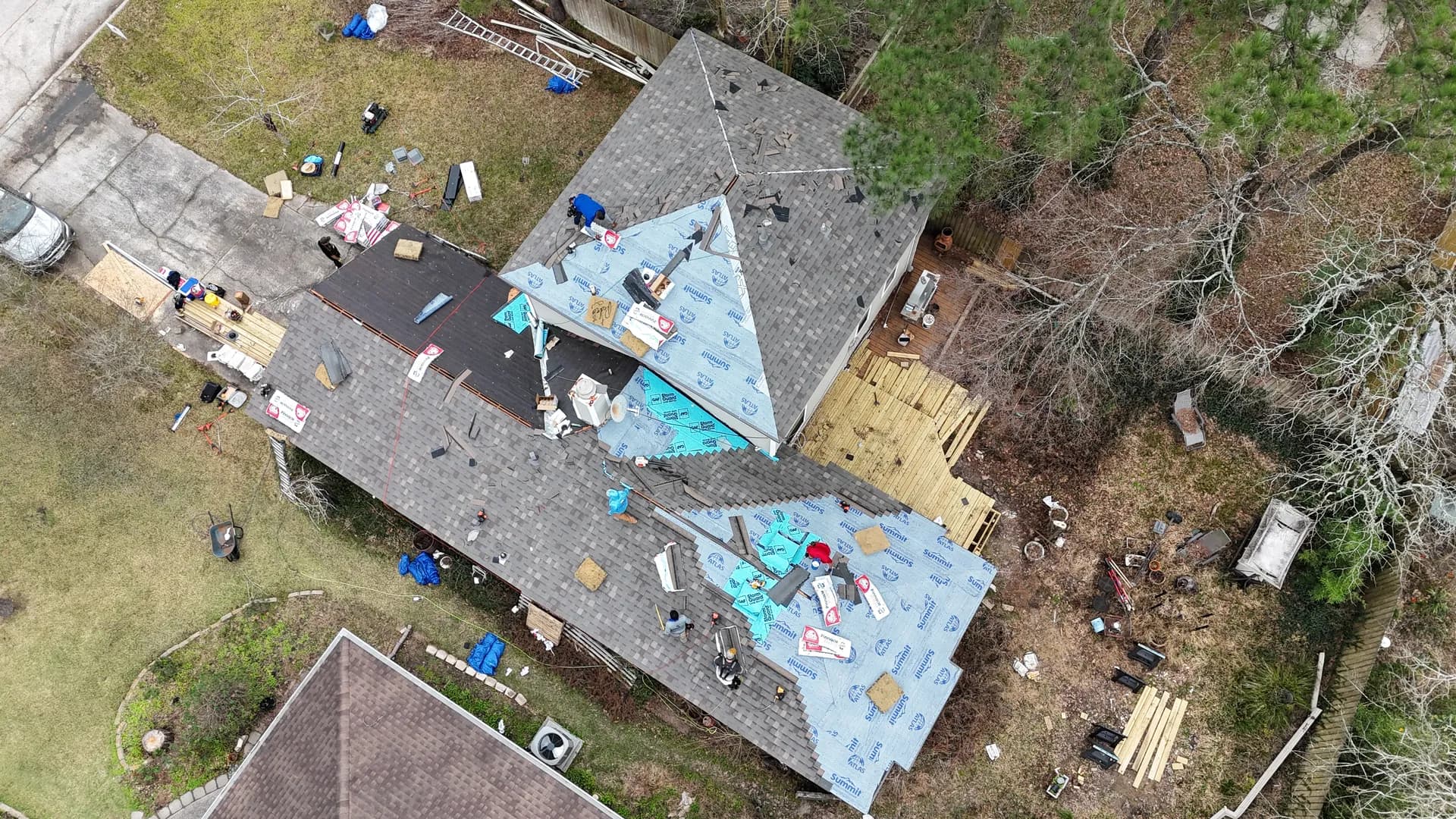
Roofing
Roof Insurance Claim Documentation
Documentation Support for Your Roof Insurance Claim
What's Included
Roof Insurance Claim Documentation in The Woodlands, TX
Dated Photographs of the Damage
Wide shots that establish the property and close shots that show the specific damage, each one dated, on every slope and on the soft metal.
Measurements and Scope
Roof measurements, slope counts, layer counts, and a written description of the work the damage requires. Facts about your roof, not opinions about your claim.
A Written Estimate for Your Use
An itemized estimate of what the repair or replacement costs, given to you. It is yours to use with your insurer however you choose.
We Can Meet Your Adjuster
If you would like us there when your adjuster inspects, we will be, so questions about roof construction and repair scope can be answered on the spot with the roof in front of everyone.
Plain Explanation of the Repair
What the damage is, what fixing it involves, and why. If part of the roof is fine we will say so, including when that means a smaller job for us.
A Clear Line We Do Not Cross
In Texas a contractor may not act as a public adjuster on a claim they are also contracted to repair. We document and we build. We do not adjust, file, or negotiate.
What a Roofing Contractor Can and Cannot Do in Texas
This page is deliberately more careful than most contractor pages on this subject, and it is worth explaining why up front.
Texas regulates public insurance adjusting. A public adjuster represents the policyholder in the claim itself: assessing the loss, valuing it, and dealing with the carrier on the homeowner's behalf. A roofing contractor who is also contracted to perform the repair may not act in that role on the same claim. The reason is straightforward. A contractor who both values your loss and gets paid from the proceeds has an obvious conflict of interest, and Texas does not permit it.
Plenty of roofing companies blur this. You will see contractors promising to take the whole claim off your hands, or to deal with the carrier so you never have to speak to them. What that describes is adjusting. We are not going to promise it, because it is not something we are permitted to do for you.
What we can do is substantial, and it is genuinely the part that most affects the outcome: making sure the damage is found, recorded accurately, and clearly explained.
What We Actually Provide
Our role is factual. We inspect the roof, we record what is there, and we tell you what repairing it involves.
The Inspection and the Record
We get on the roof and check every slope, not the accessible one. We photograph the damage in context and up close, with dates. We check the soft metal, the gutters, vents, and flashing, because those often show impact more clearly than shingles do. Where it is appropriate we mark and count test squares so the density of damage is recorded as a number rather than an impression.
You get that record. It is documentation of the condition of your property, which is yours regardless of what you decide to do next.
Measurements and Written Estimate
We measure the roof, count the slopes and the existing layers, and produce an itemized written estimate of the repair or replacement. That estimate is prepared for you. You are free to give it to your insurer, get others, or do nothing with it.
Meeting the Adjuster
If you would like us present when your adjuster inspects the property, we will be there. That is often useful, because questions about how the roof is built, what a particular detail is, and what a proper repair requires can be answered with the roof right in front of everyone rather than through three rounds of email.
Being present is not the same as representing you. We answer questions about the roof and the scope of work. The conversation about coverage and claim value is between you and your carrier.
Your Deductible
We want to be direct about this because the industry has a real problem with it.
Your deductible is yours to pay. We will not waive it, absorb it, discount our price to offset it, rebate it back to you afterwards, or structure an invoice so that it appears to have been paid when it was not. Any of those is insurance fraud in Texas and carries criminal consequences for both the contractor and the homeowner.
If a contractor offers to make your deductible disappear, what they are actually offering is to involve you in a crime, and it is a reliable indicator of how they will handle the rest of the job. Our estimate is our price, and your deductible is applied as your policy writes it.
One structural note that catches people out: in Texas, wind and hail deductibles are commonly written as a percentage of your dwelling coverage limit rather than as a flat dollar amount, typically between one and five percent according to the Insurance Information Institute. The percentage is calculated against the insured value of the home, not against the size of the loss, so the figure can be larger than expected. It is on your declarations page and it is worth checking before you decide whether to file.
Timing, and Why It Matters
Storm damage claims are time sensitive in a way that is easy to miss, because roof damage frequently does not leak right away.
Hail in particular bruises the shingle mat and strips granules without creating an immediate leak. The roof looks fine, nothing drips, and the homeowner has no reason to think about it. The failure arrives years later, by which point connecting it to a specific storm is difficult and the window your policy allows for reporting that loss may well have closed.
Texas policies contain their own deadlines, both for reporting a loss to the carrier and, separately, for filing suit if a dispute arises. Those terms vary between policies, so the answer for your house is in your policy document rather than in a general statement on a contractor's website. The Texas Department of Insurance publishes plain-language guidance on policyholder rights and the claim process, and TDI also sets the deadlines your insurer must meet once a claim is filed: after receiving all the information it needs, the carrier generally must approve or deny in writing within fifteen business days, extendable with notice and a stated reason.
The practical takeaway is simply this. After a significant storm, have the roof looked at even if nothing is leaking, and photograph what you find. Documentation created close to the event is worth far more than documentation created later.
Where This Fits With the Repair
Documentation is the beginning. What follows depends on what the roof needs.
If the damage is concentrated and the roof has life left, that is a repair, and our hail damage roof repair and wind damage roof repair pages describe what those involve. If damage is spread across multiple slopes, roof replacement is usually the honest answer and we will explain why in terms of what is on your roof.
If water is coming in now, do not wait on the claim process. Treat it as an emergency roof repair, get it stopped, and document as you go. Where hail is the suspected cause, a hail damage roof inspection produces the measured record a claim rests on. Our general storm damage roof repair page covers the wider picture.
ROYH Build Co is licensed and insured, GAF Certified Plus and Atlas Platinum certified, and serves Montgomery County and Harris County from The Woodlands and Magnolia.
Related Services
More Roofing Services
Roof Repair
Learn moreEmergency Roof Repair
Learn moreRoof Replacement
Learn moreNew Roof Installation
Learn moreRoof Inspection
Learn moreStorm Damage Roof Repair
Learn moreRoof Ventilation Installation
Learn moreSolar Attic Fan Installation
Learn moreRoof Leak Repair
Learn moreHail Damage Roof Repair
Learn moreWind Damage Roof Repair
Learn moreRoof Replacement Cost
Learn moreHail Damage Roof Inspection
Learn moreEmergency Roof Tarping
Learn moreRoof Decking Repair
Learn moreSynthetic Shingle Roofing
Learn moreGet Your Free Roof Insurance Claim Documentation Estimate
Serving The Woodlands, Magnolia, and the greater Houston area, ROYH Build Co will assess your roof insurance claim documentation needs and give you a straightforward recommendation.
Frequently Asked Questions
Will you file my insurance claim for me?
No. Filing and pursuing the claim is yours to do, and in Texas a contractor who is also contracted to repair the property may not act as a public adjuster on that claim. What we provide is documentation: dated photographs, measurements, a written estimate for your own use, and our presence at the adjuster's inspection if you want it.
Can you negotiate with my insurance company?
No. Negotiating a claim on your behalf is adjusting, and that is not something a contractor performing the repair is permitted to do in Texas. We will explain the roof and the scope of work to anyone who asks, including your adjuster, but the claim conversation is between you and your carrier.
Can you cover or waive my deductible?
No, and you should be wary of any contractor who offers to. Waiving, absorbing, discounting, or rebating a deductible is insurance fraud in Texas with criminal consequences for the contractor and the homeowner. Your deductible is billed exactly as your policy writes it.
How long do I have to report storm damage to my insurer?
That is set by your policy, and policies differ on both the deadline for reporting a loss and the time limit for filing suit. Read your policy and contact your carrier promptly rather than relying on a general rule. The Texas Department of Insurance publishes guidance on policyholder rights and the claim process.
Should I get the roof inspected if nothing is leaking?
After significant hail or wind, yes. Hail damage in particular bruises the shingle and strips granules without leaking, so the roof ages quickly while appearing fine. Finding it close to the storm gives you a documented record while it still clearly connects to that event.
What do you give me after the inspection?
Dated photographs of every slope and of the soft metal, roof measurements with slope and layer counts, and an itemized written estimate of the repair or replacement. That package is yours to use however you decide, including with a different contractor.