
Roofing
Roof Leak Repair in The Woodlands, TX
Find the Leak, Then Fix It, in The Woodlands and Magnolia
What's Included
Roof Leak Repair in The Woodlands, TX
We Trace It Before We Patch It
Water travels. The wet spot on your ceiling is usually downhill from the entry point, sometimes by several feet. We work back from the stain to the penetration instead of sealing the nearest suspicious thing.
Flashing First
Most leaks are not holes in the field of the roof. They are failures where the roof meets something else: a chimney, a wall, a vent pipe, a valley. That is where we look first because that is where leaks usually are.
Attic Side Inspection
When the attic is accessible we look at the underside of the decking. Water staining, rusted nail shanks, and damp insulation tell you where water has been running long before the ceiling does.
Honest Repair Versus Replace Answer
Some leaks are a genuine repair. Some are the third leak on a roof that is finished. We tell you which one you have rather than selling a patch on a roof that needs replacing, or a roof to someone who needs a patch.
Decking and Insulation Checked
A leak that has been running a while has usually soaked more than the shingles. We check whether the decking under the entry point has gone soft and whether wet insulation needs to come out.
LumaNail and Catch-All Cleanup
Even a small repair drops fasteners and shingle debris into the landscaping. Our LumaNail luminescent nails and Catch-All perimeter system are there so what comes off the roof leaves with us.
What To Do Right Now
If water is actively coming in, the useful things you can do take about ten minutes and none of them involve going on the roof.
Move what is under it. Get furniture, electronics, and anything paper out of the drip line. Put a bucket down and, if the ceiling is bulging, understand that the bulge is holding water. A small hole poked at the low point of a bulge with a screwdriver will drain it into your bucket in a controlled way. Leaving it alone often ends with a section of ceiling coming down all at once.
Then take pictures. Photograph the stain, the drip, the bucket, and anything damaged, and note the date. If this turns into an insurance claim later, photographs taken while it was actively leaking are worth considerably more than photographs taken after it dried. The Texas Department of Insurance makes the same point about storm damage generally: document it before any work starts.
What you should not do is climb up to look. A wet roof is slick, and the part that is leaking is by definition the part that has failed. If the water is coming in faster than a bucket can handle, get in touch and treat it as an emergency roof repair rather than a scheduled one. Where the roof is actually open, emergency roof tarping is what gets the house dry while a permanent fix is arranged.
Why the Leak Is Rarely Above the Stain
This is the single most misunderstood thing about roof leaks, and it is the reason so many repairs fail.
Water enters at a penetration, lands on the underside of the roof decking, and then follows gravity along whatever it touches. It runs down the slope of the decking, along the side of a rafter, across the top of a ceiling joist, and it drops through the ceiling at the first place it finds a gap: a light fixture, a seam in the drywall, a vent. That drop point can easily be six or eight feet from where the water actually got in, and on a low-slope run it can be further.
So a repair that starts at the ceiling and works straight up hits the wrong part of the roof most of the time. The sealant goes on a spot that was never leaking, the homeowner is told it is fixed, and the next real rain proves otherwise. Working the other direction, from the entry point down, is slower on the first visit and considerably faster over the life of the roof.
Where Leaks Actually Start
After enough of these you stop being surprised. Leaks cluster in a small number of places, and almost all of them are transitions rather than open field shingle.
Flashing at Chimneys and Walls
Anywhere the roof plane runs into something vertical, the waterproofing is done with metal flashing rather than shingles. Step flashing up a chimney side, counter flashing let into the masonry, kick-out flashing where a roof edge meets a wall. These are the highest failure locations on most roofs, partly because they involve more parts and partly because they are often the piece a previous crew reused instead of replacing.
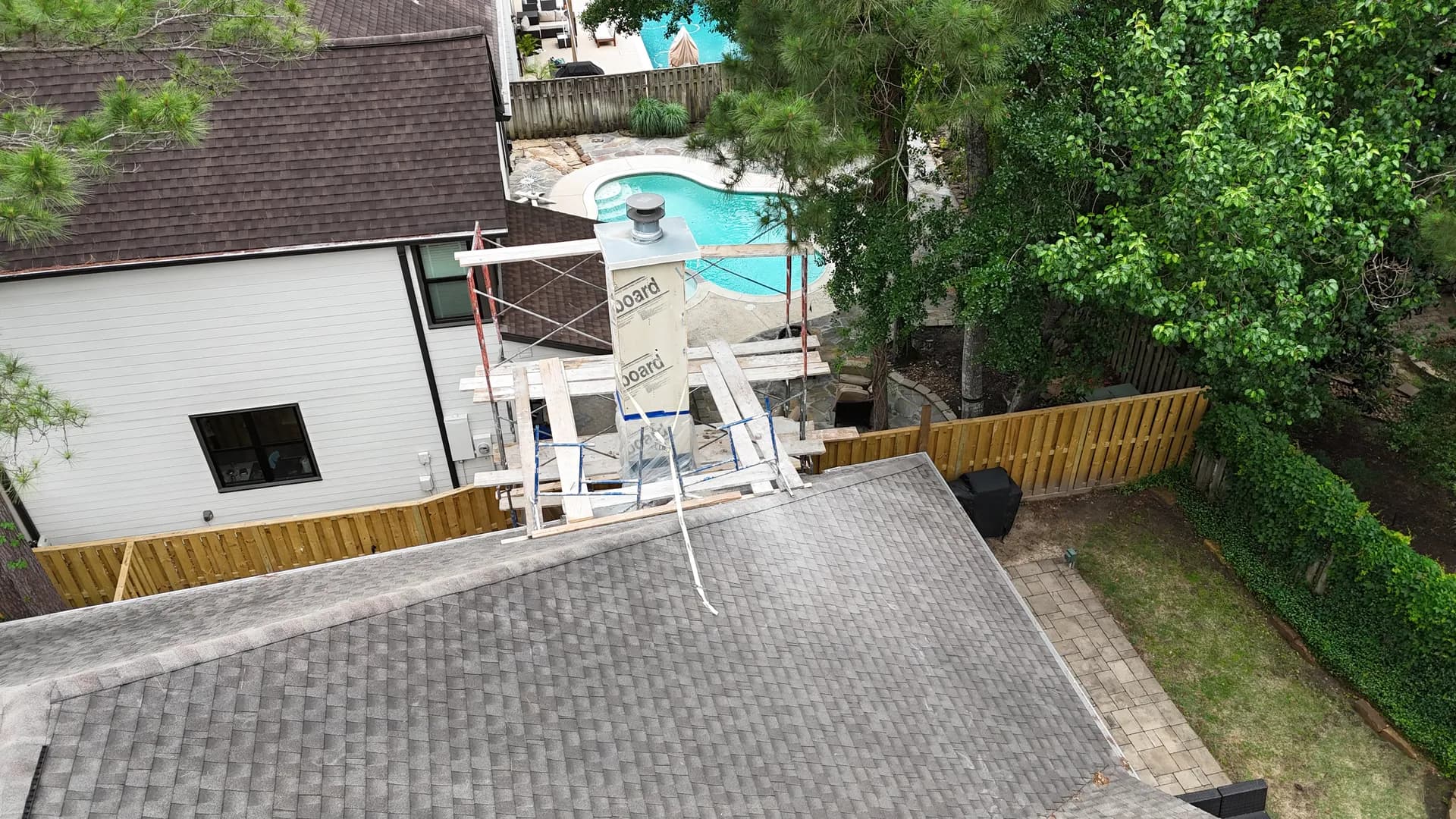
Chimneys in particular are worth a hard look. If the flashing is sound but the masonry above it is not, the water is coming through the chimney rather than the roof, and no amount of roof work will stop it. We handle both, so we can tell you which it is without the answer being convenient for us.
Valleys
A valley is where two roof planes meet and it carries more water than any other part of the roof. Debris collects there, especially under pines, and a valley that stays packed with needles holds water against the shingles instead of moving it off. Over time that is enough on its own.
Pipe Boots and Vents
The rubber collar around a plumbing vent has a shorter life than the roof it sits on. Texas sun cracks it, usually on the south-facing side first, and once it splits the water goes straight down the pipe into the attic. This is one of the cheapest repairs on a roof and one of the most common causes of a leak on a roof that is otherwise fine.
Fasteners and Blow-Offs
A nail driven high, or a shingle lifted by wind and set back down without sealing, leaves a path. These are the ones that leak intermittently, only in wind-driven rain, which makes them frustrating to chase and easy to misdiagnose.
Repair or Replace
A leak is a symptom. Whether it is worth repairing depends on what the rest of the roof looks like.
Repair usually makes sense when the roof has meaningful life left, the damage is localized, and the cause is a discrete failure: a split pipe boot, a section of flashing, a handful of shingles off a ridge. That is a genuine roof repair and we would rather do it than sell you something larger.
Replacement starts to make more sense when the leaks are multiplying, when the shingles have lost most of their granules, when the decking under several areas has gone soft, or when you are patching a roof that is near the end of its service life anyway. Spending repair money three times on a roof with two years left is worse value than putting it toward the roof replacement you will be doing regardless.
If you are unsure which situation you are in, a roof inspection answers it without committing you to anything. We will tell you plainly, and if the answer is that your roof is fine and you need one pipe boot, that is what we will say.
Leaks in This Climate
Two things about the Gulf Coast make leaks behave differently here than they do in a drier climate.
The first is rainfall intensity. A slow leak in a dry region announces itself gradually. Here, a system can drop several inches in an afternoon, and a flashing detail that has been marginal for a year fails completely in one storm. Homeowners often describe it as sudden. It usually was not.
The second is humidity and what it does to whatever got wet. Attic insulation that soaks in a July storm does not dry out quickly in air that is already saturated. Wet decking stays wet, and wet wood in a warm dark space is where you start getting problems that are no longer roofing problems. That is why we look at the decking and the insulation rather than only the shingles, and why we would rather look at a leak in the week it starts than the month it starts.
ROYH Build Co is licensed and insured and works across Montgomery County and Harris County from The Woodlands and Magnolia.
Related Services
More Roofing Services
Roof Repair
Learn moreEmergency Roof Repair
Learn moreRoof Replacement
Learn moreNew Roof Installation
Learn moreRoof Inspection
Learn moreStorm Damage Roof Repair
Learn moreRoof Ventilation Installation
Learn moreSolar Attic Fan Installation
Learn moreHail Damage Roof Repair
Learn moreWind Damage Roof Repair
Learn moreRoof Insurance Claim Documentation
Learn moreRoof Replacement Cost
Learn moreHail Damage Roof Inspection
Learn moreEmergency Roof Tarping
Learn moreRoof Decking Repair
Learn moreSynthetic Shingle Roofing
Learn moreGet Your Free Roof Leak Repair Estimate
Serving The Woodlands, Magnolia, and the greater Houston area, ROYH Build Co will assess your roof leak repair needs and give you a straightforward recommendation.
Frequently Asked Questions
How do I know where my roof is leaking?
You usually cannot tell from inside. Water enters at one point and runs along the decking or a rafter before it drops through the ceiling, so the stain is often several feet from the actual entry point. Finding it means working back from the stain, ideally with a look at the underside of the decking from the attic.
Can a roof leak be repaired, or does the whole roof need replacing?
It depends on the roof, not the leak. If the roof has life left and the cause is a discrete failure like a cracked pipe boot or a section of flashing, a repair is the right answer. If the roof is near the end of its life, or you are chasing the third leak in a year, repair money is better put toward replacement.
Should I poke a hole in a bulging ceiling?
Usually yes. A bulge is holding water, and draining it in a controlled way at the low point into a bucket is better than waiting for the section to give way on its own. Move anything valuable out from underneath first.
Why does my roof only leak in heavy or wind-driven rain?
That pattern normally points to a lifted shingle, a high nail, or a marginal flashing detail rather than an open hole. In ordinary rain the water sheds past it. In wind-driven rain the water gets pushed sideways and uphill, past the point where the roof was relying on gravity, and finds the gap.
Do you work on leaks around chimneys?
Yes, and chimneys are worth a careful look because the leak may be the masonry rather than the roof flashing. ROYH Build Co does both roofing and chimney work, so we can tell you which one is actually letting water in.