
Roofing
TPO Roofing Installation in The Woodlands, TX
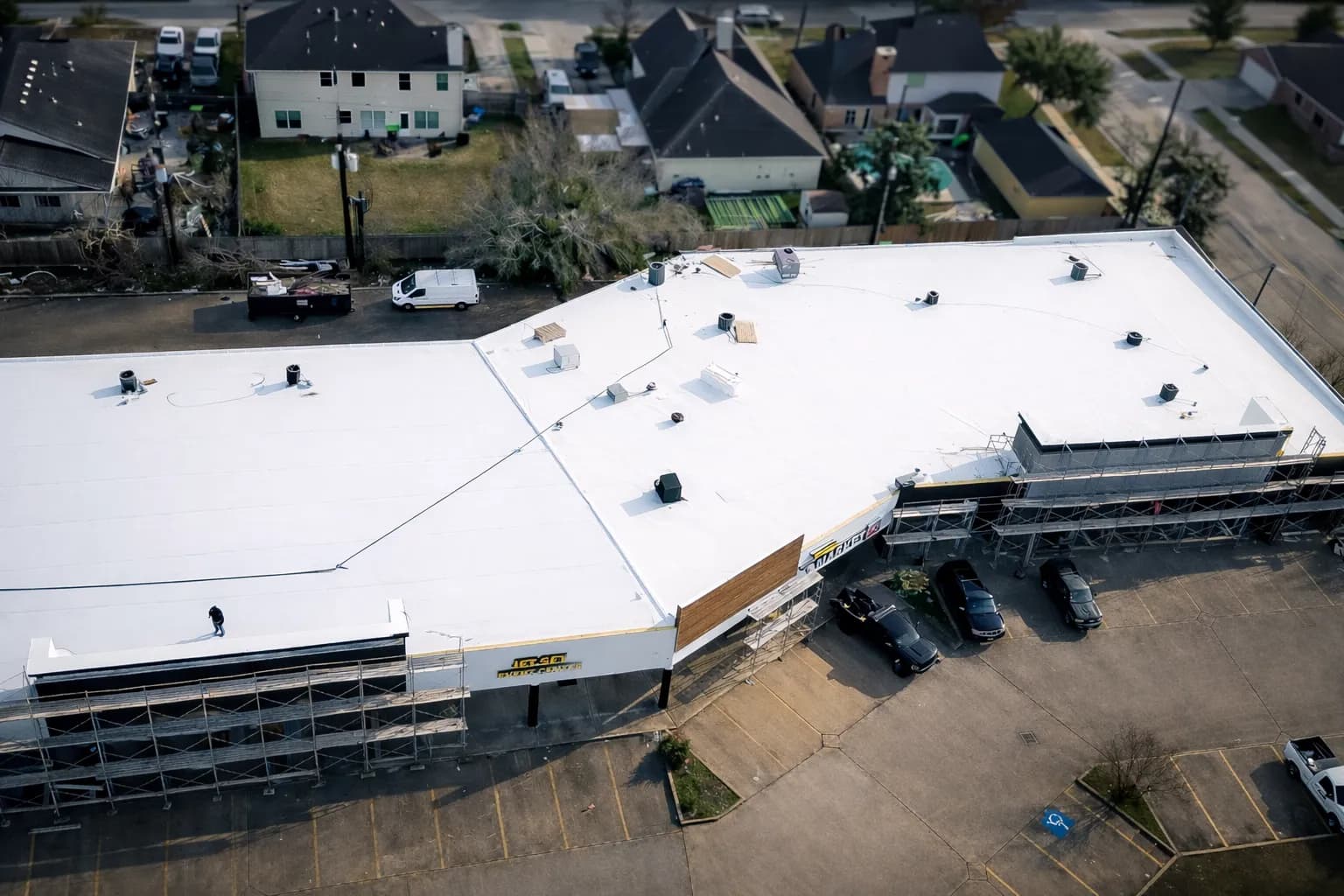
ROYH Build Co installs Versico and Duro-Last TPO roofing systems for commercial buildings across The Woodlands and Greater Houston, engineered for reflectivity, heat-welded seams, and long-term performance in Texas heat.
What's Included
TPO Roofing in The Woodlands, TX
Versico and Duro-Last TPO Membranes
Two established single-ply suppliers, giving property owners a choice between Duro-Last's prefabricated panels and Versico's field-welded TPO systems.
Heat-Welded Seams
Seams are fused with hot air into a single continuous membrane instead of relying on adhesive or tape, which is where most older flat roofs start to fail first.
Reflective, Energy-Conscious Surface
TPO's white or light gray surface reflects sunlight rather than absorbing it, easing rooftop heat gain on buildings across Greater Houston's long, hot summers.
Mechanically Attached or Fully Adhered
We install TPO using whichever attachment method fits your building's wind uplift requirements, deck type, and roof geometry.
Built for Texas Heat Cycling
TPO membranes are formulated to handle the daily expansion and contraction that comes with intense sun exposure followed by overnight cooling.
Full Lifecycle Service
From a first commercial TPO roofing installation through future repair, replacement, or coating, we work the same roof through every stage of its life.
What Is TPO Roofing, and Why Does It Dominate Commercial Low-Slope Roofs?
TPO stands for thermoplastic polyolefin, a single-ply membrane rolled out in wide sheets and welded together at the seams instead of stitched together with adhesive or tape. That single detail is most of the reason TPO has become the go-to system for flat and low-slope commercial roofs. Older seaming methods leave a weak point every few feet. A heat-welded TPO seam fuses two sheets into one continuous membrane, so there is no glue line to fail years down the road.
The other reason TPO shows up on so many commercial roofing projects is the surface itself. TPO membranes are manufactured in white or light gray, which reflects sunlight instead of soaking it in the way a dark built-up roof does, a real advantage on a Texas building baking under direct sun most of the year. TPO is also generally more budget-friendly to install than a comparable PVC system without giving up much performance for most buildings, which is why it has become the default recommendation rather than the upsell.
Duro-Last and Versico TPO Systems
ROYH Build Co installs TPO from two established suppliers and will tell you honestly which one fits your project. Duro-Last prefabricates its membrane panels in a factory, cutting and welding as much of the roof as possible before it ever reaches your building. Fewer field seams means fewer places for a seam to fail later, which is the whole argument for choosing a prefabricated system on a roof with complicated geometry.
Versico takes the more traditional route, supplying TPO membrane in wide rolls that our crew field-welds on site with automated hot-air welders for a consistent seam. Versico's product line covers a range of membrane thicknesses and reinforcement scrims, which lets us size the system to how much rooftop traffic or equipment your building actually carries rather than defaulting to one thickness for every job.
TPO Installation Methods: Mechanically Attached vs. Fully Adhered
There are two main ways to attach a TPO membrane to a commercial roof deck, and the right one depends on your building, not on habit. A mechanically attached system fastens the insulation and membrane to the deck with plates and screws, then the TPO sheet is laid over the top and welded at the overlaps. It is a fast, cost-effective method that performs well on most low-rise commercial buildings. A fully adhered system bonds the membrane directly to the substrate with adhesive instead of exposed fasteners, which tends to be the better call on roofs with a lot of penetrations, tight parapets, or higher wind uplift requirements where a cleaner surface matters more.
We do not pick the attachment method off a default spec sheet. Wind uplift ratings required for your building's height and location, the condition of the existing deck, and how many rooftop units, drains, and skylights the membrane has to work around all factor into that decision before we write an estimate.
Commercial TPO Roofing Installation
A commercial TPO roofing installation starts with a full roof evaluation, checking the deck, insulation, and drainage before any material shows up on site. From there we decide whether the existing roof can take an overlay or needs a tear-off down to the deck, since wet or damaged insulation underneath an old roof will undermine a new membrane no matter how well it is installed. Once the deck is ready, we roll out the TPO membrane, secure it using the attachment method that fits the building, and heat-weld every seam with automated welding equipment for a consistent, repeatable bond rather than a hand-torched patchwork.
The detail work is where most installation problems actually start on a poorly run job. Flashing at parapets, curbs, drains, and every rooftop penetration gets welded and sealed individually, then the whole roof gets a final walk-through inspection. That is also the stage where a PVC roofing system sometimes makes more sense instead, particularly for restaurants or industrial buildings dealing with grease or chemical exposure a standard TPO membrane was not built to resist.
TPO Roofing and Texas Heat
Commercial roofs in The Woodlands and across Greater Houston deal with a specific kind of punishment: long stretches of intense UV exposure, sudden afternoon storms, and daily temperature swings that stress a membrane's seams and attachment system. TPO's reflective surface helps here directly, keeping the roof surface cooler than a dark membrane would run under the same sun, which eases the heat load the building's HVAC system has to fight against. Heat-welded seams also hold up better under that daily expansion and contraction than seams held together with adhesive alone, since a welded seam moves as one piece of material instead of pulling at a glue line.
Flat and low-slope roofs in this region also have to manage ponding water after heavy rain, and a properly installed TPO system with correct drainage slope is built to handle that without the membrane deteriorating the way some older materials do underneath standing water. If your building has a commercial roof nearing the end of its service life, a modified bitumen roofing system is worth comparing too, but for most low-slope commercial buildings across our service area, TPO remains the system we recommend most often.
Get Your Free TPO Roofing Estimate
Serving The Woodlands, Magnolia, and the greater Houston area, ROYH Build Co will assess your tpo roofing needs and give you a straightforward recommendation.
Frequently Asked Questions
What is the difference between TPO and PVC roofing?
Both are single-ply membranes that get heat-welded at the seams, so they share the same basic installation approach. TPO is generally the more cost-effective option and works well for most commercial buildings, with a reflective surface that helps manage rooftop heat. PVC costs more but offers stronger resistance to grease, chemicals, and punctures, which is why it shows up more often on restaurants and industrial buildings with harsher rooftop conditions. We walk through both options during your estimate based on how your building is actually used.
How long does a TPO roof last?
A properly installed and maintained TPO roof from a supplier like Versico or Duro-Last can deliver many years of reliable service. Actual lifespan depends on the membrane thickness installed, the quality of the welding at the seams, and how consistently the roof gets inspected afterward. Regular inspections that catch a lifted flashing detail or a small puncture early are what keep a TPO system performing for its full expected life instead of failing ahead of schedule.
Does a white TPO roof actually help with energy costs?
A reflective white TPO membrane keeps the roof surface cooler than a dark membrane sitting under the same Texas sun, which reduces the amount of heat that transfers into the building below and eases the load on your HVAC system. How much that translates into lower energy bills depends on your building's insulation, the size and condition of your HVAC equipment, and the roof's total square footage, so we do not quote a specific savings figure. What we can say is that a reflective commercial roof is working with your cooling system instead of against it, which is more than a dark membrane can claim.