
Roofing
PVC Roofing Contractor in The Woodlands, TX
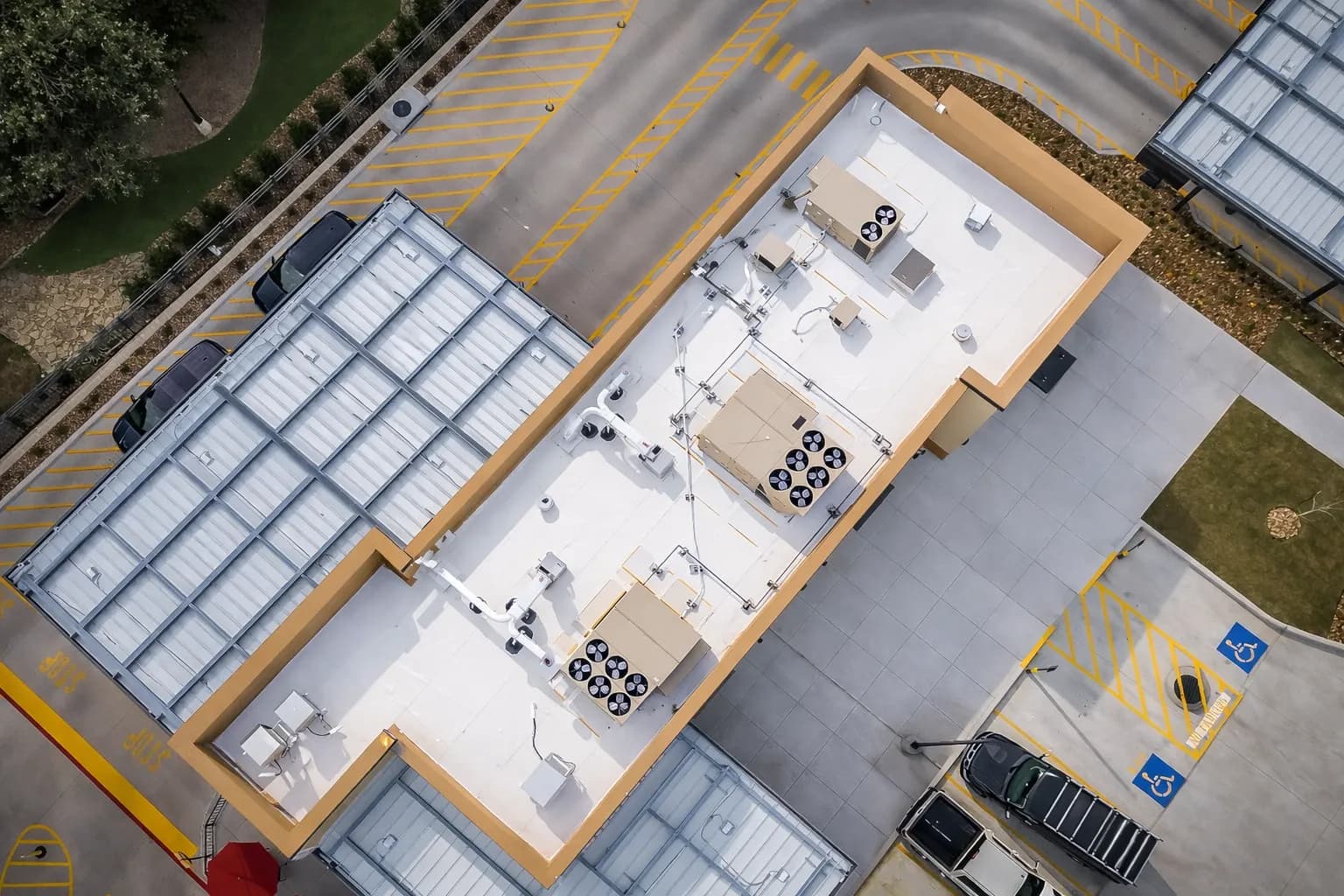
ROYH Build Co installs Versico PVC roofing systems for restaurants, industrial buildings, and any commercial roof that needs more chemical and grease resistance than a standard membrane, serving The Woodlands and the greater Houston area.
What's Included
PVC Roofing in The Woodlands, TX
Versico PVC Membrane Systems
Reinforced PVC membranes from Versico, rated for puncture resistance and long-term UV exposure on Texas commercial rooftops.
Hot-Air Welded Seams
Seams are heat-fused into one continuous sheet, not glued or taped, and every weld gets probe-tested before the section is finished.
Chemical and Grease Resistance
Built for restaurant kitchen exhaust, industrial solvents, and oils that break down standard single-ply membranes over time.
Reflective, Energy-Efficient Roofing
Light-colored PVC membranes reflect heat and cut rooftop cooling loads through Texas summers.
Honest PVC vs. TPO Recommendations
We walk your roof and tell you which system actually fits your building's use, not whichever one costs more to install.
PVC Roofing for Restaurants and Industrial Buildings That Need More Than TPO
Not every commercial building sits behind a kitchen or next to heavy machinery, but the ones that do need a roofing membrane that can take more punishment than a typical single-ply system. That's where PVC roofing usually enters the conversation. PVC membranes resist grease, oils, and industrial chemicals in a way standard commercial roofing doesn't, which is why restaurants, food service buildings, and light industrial sites lean toward it more often than a standard office park does.
Restaurant rooftops are a particular problem. Grease vent exhaust settles on the roof surface month after month, and a membrane that isn't built to resist it starts breaking down faster than its warranty assumes. We've seen TPO roofs on restaurant buildings age poorly for exactly that reason. PVC's chemical makeup resists that kind of breakdown, so a kitchen exhaust system stops being a long-term threat to the roof underneath it. Industrial buildings deal with a similar problem: solvents, oils, and airborne chemical residue that a general-purpose membrane was never engineered to handle. ROYH Build Co installs commercial roofing across Montgomery and Harris counties, and PVC is the system we reach for when a building's actual use, not just its roof slope, calls for something tougher.
Hot-Air Welded Seams Built for Long-Term Watertightness
Every PVC roof we install gets its seams joined with hot-air welding, not glue or seam tape. A hot-air welder heats the overlapping edges of two PVC sheets until the material itself starts to soften, then fuses them together under roller pressure. Once it cools, the seam isn't two pieces of membrane sitting next to each other anymore. It's one continuous sheet of plastic.
That matters more than it sounds like it should. Adhesive seams degrade over time as the bonding agent itself ages, especially under the UV exposure and heat cycling a Texas rooftop deals with every summer. A welded seam doesn't have that failure mode, because there's no separate adhesive layer to break down. It's the same principle behind solvent-welded PVC pipe fittings. The seam becomes part of the material instead of something holding two pieces of material together. We probe-test every welded seam before we consider a section finished, checking that the weld penetrated the full width of the overlap rather than just tacking the edges, since a weak seam is the most common cause of a leaking single-ply roof.
PVC vs. TPO Roofing: An Honest Comparison
PVC and TPO get compared constantly, and most of what you'll read online oversimplifies it. Here's the honest version. Our TPO roofing is the more cost-effective single-ply option for most commercial buildings, and it performs well for the majority of roofs we install, offices, retail centers, and warehouses without heavy chemical exposure. If your building doesn't have a specific reason to need PVC, TPO is usually the smarter dollar-for-dollar choice, and we'll say so upfront instead of upselling a system you don't need.
PVC costs more than TPO, and it earns that cost back on buildings with real chemical or grease exposure, not on a standard office roof. Its resistance to oils, chemicals, and punctures outperforms TPO in those specific conditions, and its hot-air welded seams hold up the same way TPO's do. What PVC doesn't do is make an ordinary flat roof better than TPO already makes it. Both are reflective, both cut cooling costs versus a dark membrane, and both hold up to Texas heat when installed correctly. The honest answer to which one you need almost always comes down to what happens on your roof day to day, not which system sounds more advanced.
Versico Systems and Where PVC Roofing Is Worth It
ROYH Build Co installs Versico PVC roofing systems, the same commercial single-ply supplier behind our TPO installations. Versico's PVC membranes come reinforced for puncture resistance and rated for the kind of sustained UV exposure a Texas rooftop takes on for years without a break. Because we install both product lines from the same supplier, we aren't steering you toward whichever system is easier for us to source. We're recommending the one that actually matches your building.
PVC roofing is worth the extra cost on restaurant rooftops, industrial buildings with chemical or solvent exposure, and any commercial roof with heavy rooftop equipment traffic where punctures are a real risk. It's less necessary on a straightforward office or retail roof, where TPO usually covers the job for less money. If an existing roof is failing and needs a full flat roof replacement rather than a repair, that's the right time to reconsider which membrane goes back down, PVC included. See our full commercial roofing services for everything else we install and repair across The Woodlands and Greater Houston.
Get Your Free PVC Roofing Estimate
Serving The Woodlands, Magnolia, and the greater Houston area, ROYH Build Co will assess your pvc roofing needs and give you a straightforward recommendation.
Frequently Asked Questions
What is the difference between PVC and TPO roofing?
Both are single-ply membranes joined with hot-air welded seams, but PVC resists chemicals, grease, and punctures better than TPO, which makes it the stronger choice for restaurant rooftops and industrial buildings. TPO costs less and performs well on standard commercial roofs without that kind of exposure. We walk your roof and recommend the system that fits your building's actual use, not the more expensive option by default.
Is PVC roofing worth the extra cost over TPO?
It depends on what happens on your roof. If your building has a restaurant kitchen exhaust, industrial chemical exposure, or heavy rooftop equipment traffic, PVC's added resistance usually earns back the extra cost over the life of the roof. On a standard office or retail building without that kind of exposure, TPO typically does the job for less money, and we'll tell you that directly rather than upselling PVC you don't need.
Does ROYH Build Co install Versico PVC roofing systems?
Yes. We install Versico PVC membrane systems, reinforced for puncture resistance and built for long-term UV exposure on commercial roofs across The Woodlands and Greater Houston. We install Versico's TPO and modified bitumen product lines as well, so our system recommendation is based on your building, not on what we happen to have on the truck.
How long do hot-air welded PVC roof seams last?
A properly welded PVC seam fuses two sheets of membrane into one continuous piece of material, which avoids the slow adhesive breakdown that can affect glued or taped seams over years of UV exposure and heat cycling. We probe-test every seam before a section is considered finished to confirm the weld penetrated the full width of the overlap, not just the edges.