
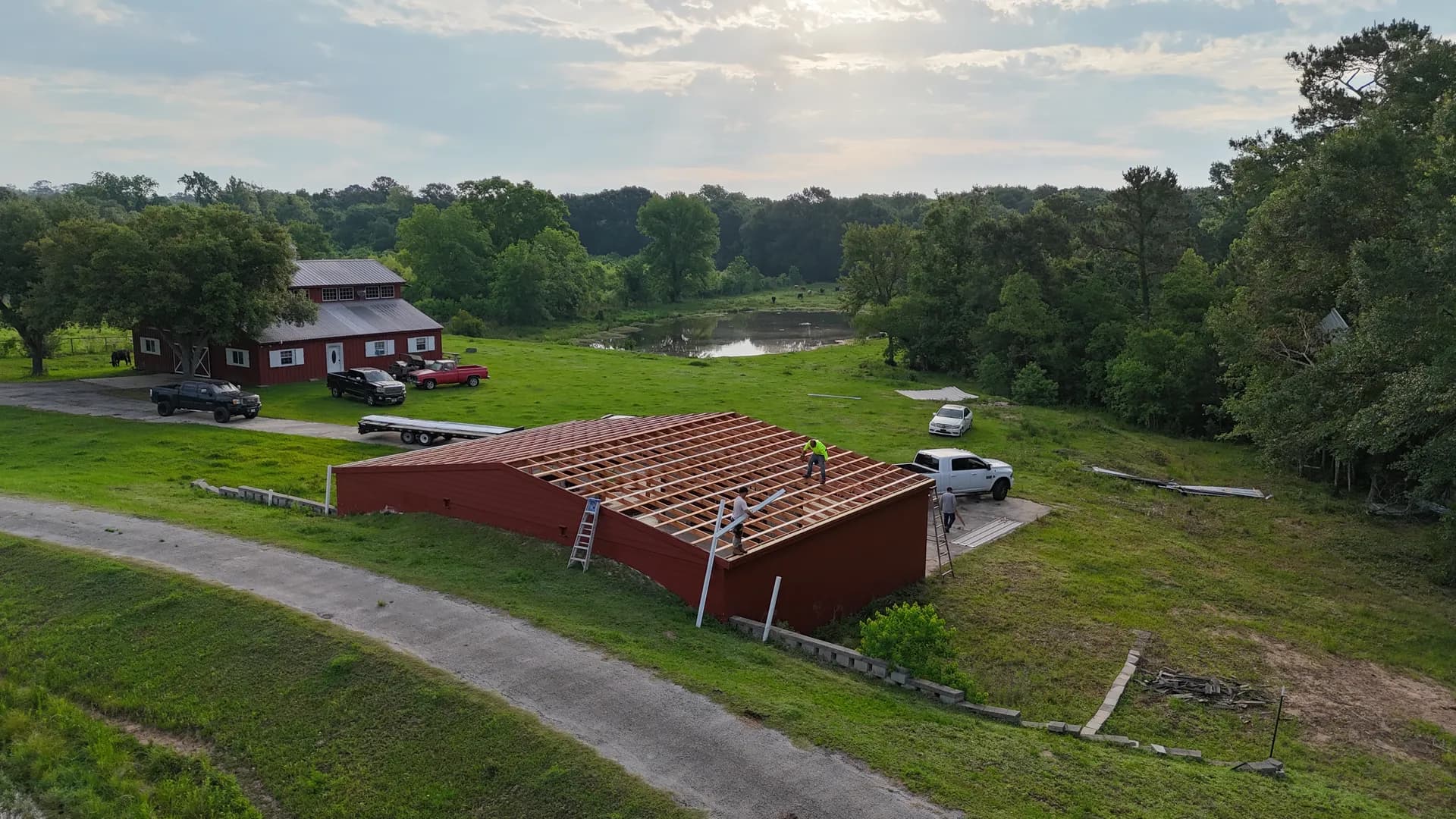
Roofing
Metal Roof Installation Process
What Happens on a Metal Roof Installation
What's Included
Metal Roof Installation in The Woodlands, TX
Measured and Ordered, Then Scheduled
Panels are cut to length for your roof. Nothing gets scheduled until material is confirmed, because a partial delivery strands a job mid-run.
Tear-Off and Decking First
The old roof comes off and the deck gets inspected before any panel arrives on the roof. Soft sheathing is replaced at the agreed rate.
Panels Come Long
A standing seam panel can run the full slope in one piece. Long material does not corner, so the route in and the staging area are planned in advance.
Flashing Is Most of the Skill
Field panels go fast. Valleys, sidewalls, chimneys, and penetrations are where the days go and where installation quality actually shows.
Room to Move
Metal expands and contracts daily. Clips, fastener placement, and panel end details have to allow that or the roof fights itself.
Cleanup as We Go
Metal offcuts and fasteners are sharp and easy to lose in grass. LumaNail luminescent nails and the Catch-All perimeter system are how we find them.
What This Page Is For
If you are still deciding whether metal is right for your house, the metal roofing page covers the material and metal roof cost covers what drives the price. Start there.
This page assumes you have decided, and answers the questions people ask next: what is the sequence, how long does it take, what happens to my driveway and my landscaping, and what should I be watching for. Those are practical questions and they rarely get answered properly before the crew arrives.
Before Anything Happens on Site
Metal is less forgiving than shingles about starting before you are ready, because the material is made for your roof specifically.
Measurement and Order
Panels are cut to length. That means the roof has to be measured accurately, slope by slope, before anything is ordered, and it means a mistake is not something you correct from stock on the truck. Colour and profile are confirmed at this stage too, and lead time on a specific colour can be the thing that sets your schedule rather than crew availability.
We do not schedule a start date until material is confirmed. Beginning a tear-off against a delivery that has not landed is how a roof ends up open over a weekend.
Access and Staging
This is the part homeowners are most surprised by. Standing seam panels commonly run the entire slope in a single piece, which can mean lengths of twenty feet or more. Long material does not turn corners, does not come through a narrow side gate, and cannot be carried around a pool enclosure.
So before the job we work out where material lands, how it gets to the roof, where the dumpster sits, and what has to be moved or protected. On a tight lot with mature landscaping that conversation determines the schedule more than the roof size does.
The Sequence on Site
Roughly in order, though a large or complex roof overlaps these.
Tear-Off
The old roof comes off. On residential work we tear off rather than installing over the existing roof, and it is worth saying why: going over shingles hides the deck from everyone, traps heat against the underside of the new panels, and makes the eventual removal worse. It saves a day now and costs more later.
Decking Inspection
With the roof stripped, the deck is visible for the only time in twenty years. It gets walked and looked at, and anything soft or delaminated is replaced in full sheets landing on framing. This is the one line item nobody can price in advance, which is why the per-sheet rate should already be in your estimate. Our roof decking repair page covers what causes it and what to ask.
Underlayment and Details
A high-temperature underlayment goes down, because the underside of a metal panel in Texas sun gets hot enough to degrade ordinary felt. Drip edge, valley metal, and flashings at walls and chimneys are set. This is unglamorous and it is where the roof is actually waterproofed.
Panels
Field panels go on faster than people expect. A straightforward slope can move very quickly, which is why homeowners sometimes think the job is nearly finished on day two when it is not. Panels are set with clips on a standing seam system, or through-fastened on an exposed fastener system, and seams are closed as the run progresses. Our standing seam metal roofing page covers that system if you are still choosing between the two.
Trim, Flashing, and Cleanup
Then the part that takes the time. Ridge and hip caps, sidewall and endwall flashing, closures, pipe boots, and anything around a chimney or a skylight. On a cut-up roof this is the majority of the labour, and it is the part where a fast, cheap installation shows itself two years later.
Where Metal Installations Go Wrong
Three failure modes, all avoidable, all worth asking about.
No allowance for movement. Metal expands and contracts measurably every day, and on long panel runs that adds up. A system installed without room to move elongates its own fastener holes and works its seams open. On a standing seam roof the clips exist precisely to absorb this. Fastening a standing seam panel rigidly, or later drilling through one to mount something, defeats the design. Our metal roof repair page covers what that looks like once it has happened.
Wrong underlayment. Standard felt under metal in this climate degrades. High-temperature underlayment costs slightly more and is not optional here.
Rushed flashing. Field panels are quick and details are slow, so the temptation on a fixed price is to hurry the details. Almost every metal roof leak we are called to is a flashing or penetration failure rather than a panel failure.
What to Expect as a Homeowner
It is loud. Tearing off a roof and setting metal panels over your head is not a work-from-home-friendly two days, and there is no version of it that is quiet.
Timeline depends far more on complexity than on area. A simple gable roof can be done quickly. A roof with multiple planes, dormers, valleys, and a chimney takes considerably longer for the same square footage, because the time is in the details rather than the field.
Metal offcuts and fasteners are sharp and disappear into grass, which is why we run the Catch-All perimeter system during tear-off and use LumaNail luminescent nails: they can be found, which makes a thorough sweep verifiable rather than a matter of trust.
For barns, shops, and outbuildings the sequence differs because the framing does, and agricultural metal roofing covers that. ROYH Build Co supplies through McElroy Metal, is licensed and insured, and works across Montgomery County and Harris County.
Get Your Free Metal Roof Installation Estimate
Serving The Woodlands, Magnolia, and the greater Houston area, ROYH Build Co will assess your metal roof installation needs and give you a straightforward recommendation.
Frequently Asked Questions
How long does a metal roof installation take?
Complexity matters far more than size. A simple gable roof can go quickly, while a roof of the same area with multiple planes, dormers, valleys, and a chimney takes considerably longer, because the time is in the flashing details rather than the field panels.
Can metal go over my existing shingles?
It is sometimes done and we do not recommend it on residential work. Installing over shingles hides the decking from everyone, traps heat against the underside of the panels, and makes the eventual removal a larger job. The saving is real on the day and borrowed from later.
Why does the material have to be ordered before scheduling?
Because panels are cut to length for your specific roof, so there is no equivalent of pulling extra bundles off the truck. We do not set a start date until material is confirmed, since beginning a tear-off against an unlanded delivery risks leaving a roof open.
Do you need special access for the panels?
Often, yes. Standing seam panels can run the full slope in one piece, sometimes twenty feet or more, and long material does not turn corners or fit through a narrow side gate. Where material lands and how it reaches the roof gets worked out before the job rather than on the morning.
What is the most common installation mistake?
Not allowing for thermal movement. Metal expands and contracts daily, and on long runs that is real distance. A panel fastened rigidly, or drilled through later to mount a bracket or dish, elongates its own fastener holes and works its seams open over time.