Roofing
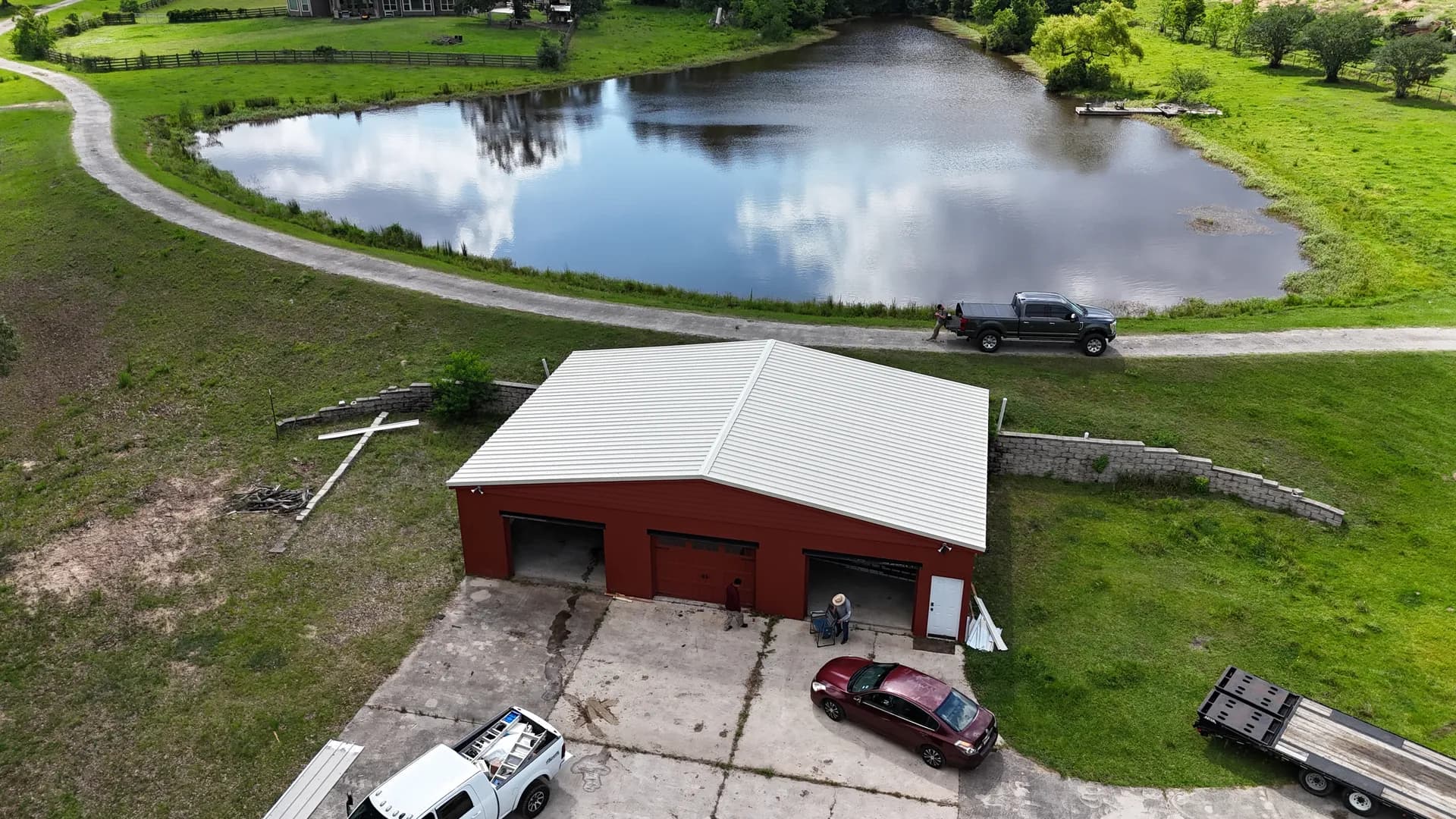
Barn and Agricultural Metal Roofing in Magnolia, TX
Barn and Agricultural Metal Roofing on Acreage North of Houston
What's Included
Barn and Agricultural Metal Roofing in The Woodlands, TX
Standing Seam and Exposed Fastener Panels
We install both concealed fastener standing seam and traditional exposed fastener panel systems, and we walk through which one fits the building and the budget conversation before anything is ordered.
McElroy Metal Supply
Panels come from McElroy Metal, the same metal roofing supplier behind our residential standing seam work, so agricultural jobs are not sourced from whatever is closest that week.
Sized to Open Purlin Framing
Barns and shops are typically framed with wood or steel purlins on wide spacing instead of a solid deck. Panel gauge and fastener pattern get selected for that framing, not adapted from a house.
Barns, Shops, and Outbuildings
Working barns, detached workshops, equipment and hay storage, carports, and other outbuildings on acreage are all in scope.
Access and Staging for Acreage
Outbuildings often sit well off the road, past a gate, and near livestock or equipment. We plan the material drop, dumpster placement, and crew access with you before the first truck arrives.
LumaNail and Catch-All Cleanup
Loose fasteners in a pasture or a drive are a genuine hazard for tires and animals. Our LumaNail luminescent nails and Catch-All perimeter debris system exist so cleanup is thorough, not approximate.
Why Metal Is the Default on Barns and Outbuildings
Nearly every working barn, shop, and equipment shed in this part of Texas wears a metal roof, and it is not just tradition. Agricultural buildings are usually framed with purlins on wide spacing and no solid deck underneath, which rules out shingles outright. Shingles need a continuous nailable surface. Metal panels span between purlins on their own, so the panel is both the roof covering and the structural skin.
Metal also suits how these buildings get used. Roof pitches on barns and shops are often shallower than a house, and a low slope is where shingles start to struggle with wind-driven rain. Panels shed water at slopes a shingle roof cannot handle. Add in a reflective finish over an uninsulated space and a shop stays noticeably more workable in an August afternoon than one under a dark absorbent roof. Our broader metal roofing page covers the material itself in more depth.
Standing Seam Versus Exposed Fastener Panels
There are two ways to put metal on an agricultural building, and they age very differently.
Exposed Fastener Panels
Exposed fastener panels, sometimes called R-panel or through-fastened panel, are screwed straight through the face of the metal into the purlin below, with a rubber washer under each screw head sealing the hole. This is the traditional barn roof. It goes on efficiently, it is the more accessible option on a large span, and it has been the standard on outbuildings in this area for a long time.
The trade-off is the fasteners themselves. Every screw is a penetration through the roof surface, and the washers are the part that eventually gives out under UV and thermal movement. That is a maintenance item rather than a defect, and it is a manageable one. It is also the main reason we talk through both systems instead of quoting one by default.
Standing Seam
On a standing seam roof the fasteners are hidden. Clips hold the panels to the framing and the seams are locked upright above the water line, so there is no penetration through the roof plane and no washer to age out. The clips also let panels expand and contract with temperature instead of working against fixed screws, which matters on the long unbroken runs common to barn roofs.
Standing seam carries a higher material and labor cost than a through-fastened panel. Where it tends to earn that back is on a building you intend to keep for a long time, one with a lower slope, or one storing something you would rather not have dripped on. We install both and will tell you plainly which we think fits your building.
Working on Acreage
A barn roof is not a driveway job. The building may sit several hundred feet past a gate, on ground that turns soft after a week of rain, with animals, equipment, or fencing in the way of the obvious staging spot. We would rather sort that out on the estimate visit than discover it with a loaded truck at the gate.
When we come out we look at how material can reach the building, where a dumpster can sit without blocking you in, and whether anything needs to be moved or penned before the crew starts. Metal panels arrive in long lengths and do not corner well, so the route in genuinely determines the schedule.
Cleanup gets the same attention. Tearing an old roof off an outbuilding scatters fasteners and metal scrap across ground that livestock walk on and tractors drive over. Our LumaNail luminescent nails and Catch-All perimeter system are there so what comes off the roof leaves with us.
Where We Work
ROYH Build Co serves The Woodlands and Magnolia, TX, which puts most of the acreage in this region inside our normal service radius. We handle barn and outbuilding roofs across Montgomery County, out through Waller County and Grimes County, and north into Walker County. If your property sits outside those, get in touch and we will tell you honestly whether it is a drive we can make.
Related Services
More Roofing Services
Get Your Free Barn and Agricultural Metal Roofing Estimate
Serving The Woodlands, Magnolia, and the greater Houston area, ROYH Build Co will assess your barn and agricultural metal roofing needs and give you a straightforward recommendation.
Frequently Asked Questions
Can you put a metal roof on a barn that has no roof deck?
Yes. Most agricultural buildings are framed with wood or steel purlins on open spacing and have no solid deck, and metal panel systems are designed to span that framing on their own. We measure the existing purlin spacing and the roof span, then select a panel profile and gauge rated for it. A shingle roof would require adding a full deck first, which is one of the reasons metal is the standard choice on these buildings.
Should I use standing seam or exposed fastener panels on a barn?
Exposed fastener panels are the more accessible option and remain the traditional barn roof in this area, but every screw is a penetration and the sealing washers age out over time. Standing seam hides the fasteners, has no penetrations through the roof plane, and handles the thermal movement of long panel runs better, at a higher material and labor cost. Lower roof slopes, longer intended service life, and sensitive storage underneath all push toward standing seam. We install both and will give you a straight recommendation for your building.
Do you build barns and steel buildings, or only roof them?
We are a roofing contractor. We install and replace metal roofing on existing barns, shops, carports, and outbuildings, including deck and framing repair where the roof structure has deteriorated. We do not erect new steel buildings or pole barns from the ground up.
Can you get equipment out to a building that is far off the road?
Usually, but it is worth sorting out ahead of time. Metal panels come in long lengths that do not turn corners well, and material trucks and dumpsters need somewhere firm to sit. When we come out for the estimate we look at the gate, the route in, and where things can stage, so the crew is not improvising on the first morning.