Stucco or James Hardie Siding: Which Is Better for Texas Homes?
By Seth WeHunt · · 8 min read
When Texas homeowners weigh stucco or James Hardie siding, they usually start by asking which material is "better." That's the wrong first question. Both hold up fine on Texas homes when they're installed correctly. The real question is which one solves the problem your house actually has. It's also about which one fits how you want to live with your exterior for the next twenty years. ROYH Build Co makes its own stucco and installs James Hardie fiber cement siding. We don't have a horse in this race the way a contractor who only offers one material does. Here's the honest version, not the version that happens to favor whichever crew is free next week.
Two Very Different Ways to Cover a Wall
Stucco is a wet-applied, cement-based coating that goes on in coats over a lath and moisture barrier. It cures into a single, seamless surface. There's no seam to fail because the whole wall is essentially one piece.
James Hardie siding is the opposite approach. It's a pre-engineered fiber cement board, manufactured off-site to a consistent formula and installed as individual planks or panels. Every board is identical before it ever touches your house.
Neither approach is inherently superior. They just move the risk to different places. With stucco, the risk sits with the person applying it. With Hardie, it sits with the installer getting flashing and clearance right on a product that's already engineered correctly.
How Each Handles Gulf Coast Humidity and Moisture
This is where the conversation actually matters, because Texas humidity is unforgiving toward exteriors that aren't detailed properly.
Stucco doesn't fail because it's stucco. It fails because of what's behind it. A weather-resistant barrier, a proper weep screed at the bottom, and flashing lapped right at every window decide whether a wall sheds moisture or traps it. Get those details right, and stucco holds up fine through hot, humid summers and the freeze-thaw swings most winters bring. Get them wrong, and water gets trapped behind the coating. You won't know until the sheathing underneath is already damaged. That's a slow, costly kind of failure, and it's exactly why we treat stucco as its own discipline rather than a finish coat. Stucco installation is a moisture-management job wearing a finish job's clothes.
James Hardie takes a different route. The company formulates its HZ10 product line for humid climates like the Gulf Coast. That's a different mix than what ships to drier parts of the country. Fiber cement doesn't soak up water the way wood does, and it doesn't feed termites. That engineered consistency cuts out a lot of the guesswork you get with a hand-applied material. It doesn't remove installer error entirely, though. Skip clearance at grade or flashing at a window head, and moisture still finds a way in.
The honest takeaway: this isn't really stucco versus Hardie on moisture performance. It's controlled application versus engineered material. Both work well in Texas humidity. Both fail the same way, quietly, when a crew treats moisture detailing as an afterthought.
Aesthetics: Mediterranean Texture vs Classic Lap and Panel
This is usually where the decision actually gets made, and it should be, because both materials perform reasonably well structurally.
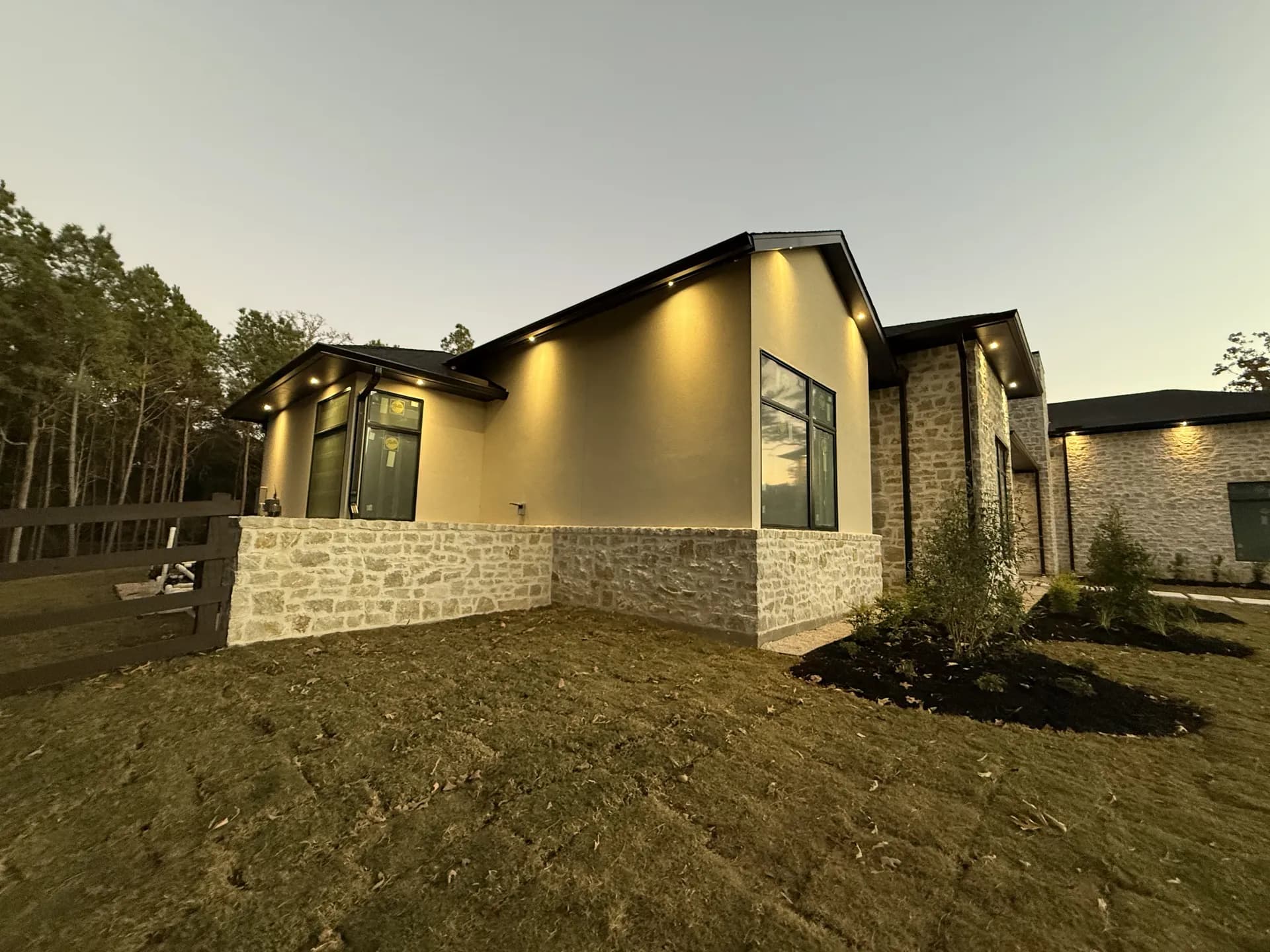
Stucco gives you a seamless, sculptural exterior that no other material quite replicates. It suits Spanish colonial, Mediterranean, Tuscan, and custom architectural styles that show up across Texas hill country builds and higher-end suburban developments. You can vary the texture from smooth to heavily troweled, and you can tint it in the mix rather than paint it on afterward.
James Hardie plays a different game. James Hardie siding comes in horizontal lap profiles for a traditional look. It also comes in vertical panels for something more contemporary, and shingle-style profiles that mimic cedar shakes without the upkeep. Factory-applied ColorPlus finishes hold color longer than a field-painted surface. That matters in a climate with this much sun on an exterior every year.
If your house already leans Mediterranean or Spanish colonial, stucco tends to be the material that actually looks like it belongs there. If you're working with a craftsman, farmhouse, or traditional American exterior, Hardie usually reads as the more natural fit.
Maintenance Realities Over the Life of the Siding
Neither material is maintenance-free. Anyone who tells you otherwise is selling you something.
Stucco is durable, but it can develop hairline cracks over time. Houses settle. Temperatures cycle through the seasons. This shows up more with synthetic (EIFS) systems than traditional three-coat stucco, but both need occasional attention: re-caulking at penetrations, checking flashing, and patching cracks before they widen into something that lets water in. Working with a contractor who makes its own stucco has a real upside here, because texture matching on a repair comes down to controlling the mix rather than ordering the closest thing to it.
James Hardie doesn't crack the way stucco can, and it won't rot the way wood does. Its long-term maintenance shows up at cut edges and butt joints. Those need to stay primed and sealed so moisture can't wick in from an exposed edge. A factory ColorPlus finish stretches out the repaint interval a lot compared to a field-applied paint job. It's not a forever finish, though. It just needs attention on a longer cycle than stucco's crack-and-patch rhythm.
Durability in Texas Hail and Wind
Texas storm seasons put both materials to a real test, and they respond differently.
Stucco is rigid and mechanically secured to a wall through metal lath, so it isn't going to peel back or blow off in wind the way a lighter cladding might. Its weak point is impact. Large hail can chip or crack the surface, especially near corners and edges where the coating runs thinner.
James Hardie fiber cement is dense and holds up well against wind-driven debris and typical Texas hail sizes. It won't warp in heat or go brittle in a cold snap the way some vinyl does. Unusually large hail can still chip the surface, but the material generally shrugs off storm damage better than lighter siding options.
Both materials are mechanically fastened rather than relying on adhesive or friction, which means wind uplift isn't the main concern with either one. Impact resistance is where the real difference shows up, and it's a close call that depends more on hail size and angle than on which material you chose.
Which Material Fits Which Home
Architecture should drive most of this decision, but budget posture and maintenance appetite matter too.
Stucco is a labor-intensive, hand-finished process applied in multiple coats over several days. It's more art than assembly, and that shows up in the timeline. It rewards homeowners who want a specific architectural statement and who are comfortable with periodic crack-and-patch maintenance in exchange for a look nothing else quite matches.
James Hardie is manufactured off-site and installed as pre-formed boards. That usually means a more predictable installation timeline. It suits homeowners who want a lower-maintenance exterior, especially anyone comparing fiber cement siding against wood or vinyl rather than against stucco specifically. If minimizing ongoing upkeep is the priority, Hardie usually wins that comparison.
An Honest Decision Framework
Skip the marketing angle and use this instead:
- If your home's architecture already leans Mediterranean, Spanish colonial, or Tuscan, stucco is probably the right call. It's the material that look was designed around.
- If you're re-siding a traditional, craftsman, or farmhouse-style home and want to minimize how often you're thinking about your exterior, James Hardie is the more practical choice.
- If your current siding failed and you're rebuilding from scratch with no strong style preference either way, it comes down to maintenance. Are you willing to do the hands-on upkeep stucco asks for in exchange for its look, or would you rather have a lower-maintenance board that reads more traditional?
- If you're not sure, walk both options with a contractor who installs both and has no reason to steer you toward whichever one is easier for them that week.
That last point is the actual differentiator here. A lot of siding contractors specialize in one material and frame every conversation around it. We make our own stucco and install James Hardie to manufacturer spec, so the recommendation you get is based on your house, not our schedule.
Stucco vs James Hardie Siding at a Glance
| Category | Stucco | James Hardie |
|---|---|---|
| Moisture handling | Depends entirely on correct application and detailing | Engineered formula resists moisture and pests out of the box |
| Look | Seamless, sculptural, Mediterranean and Spanish colonial styles | Lap, panel, and shingle profiles for traditional to contemporary homes |
| Maintenance | Watch for hairline cracks, re-caulk penetrations periodically | Seal cut edges and joints, longer repaint cycle with ColorPlus |
| Impact resistance | Rigid, can chip near corners under large hail | Dense fiber cement, generally resists typical hail and debris well |
| Install process | Hand-applied in multiple coats, longer timeline | Pre-manufactured boards, more predictable installation schedule |
| Best fit | Mediterranean, Spanish colonial, and custom architectural homes | Craftsman, farmhouse, traditional, and contemporary homes |
Both materials do well on Texas homes when the crew installing them actually respects what each one needs. The wrong contractor can make either material fail early. The right one can make either material perform for decades.
Are you comparing siding options for a new build, a full replacement, or storm repair? ROYH Build Co can walk your property and look at your architecture. We'll give you a straight recommendation between stucco and James Hardie instead of pushing whichever material happens to be easiest for us to schedule. Contact us for a free estimate and we'll talk through both, honestly.
Seth WeHunt
Owner, ROYH Build Co
Get Your Roofing Quote
Serving The Woodlands, Magnolia, and greater Houston, ROYH Build Co offers free inspections and straightforward estimates.