
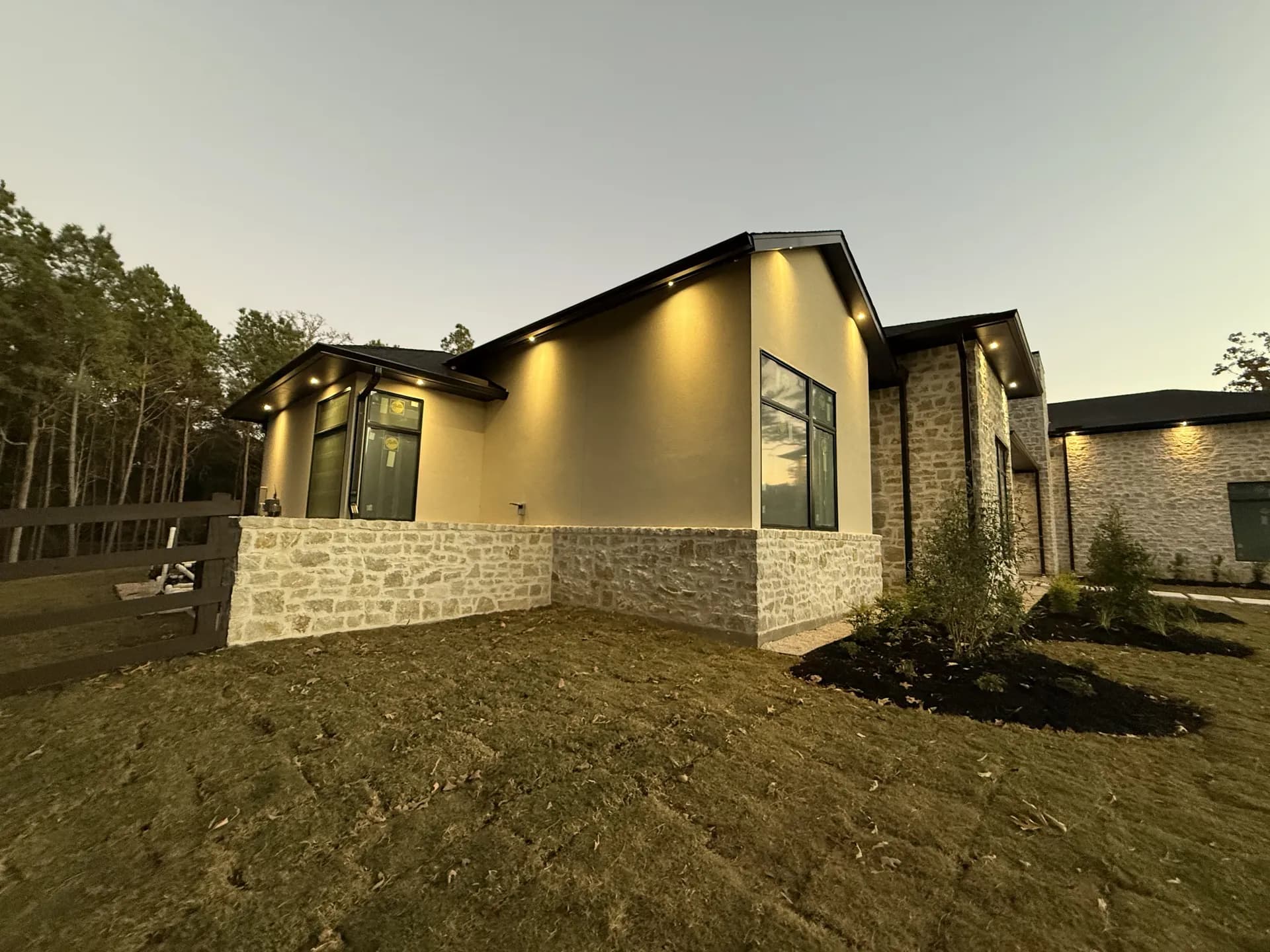
Siding
Stucco Installation in The Woodlands, TX
ROYH Build Co makes its own stucco and builds it up from scratch coat to finish, giving The Woodlands homeowners direct control over quality on every stucco installation.
What's Included
Stucco Installation in The Woodlands, TX
Stucco Made In-House
We mix our own stucco, so quality control runs from the sand-to-cement ratio through the base coat to the final texture pass.
Traditional Three-Coat System
Scratch coat, brown coat, and finish coat, applied over lath the way stucco has been built for durability for decades.
Moisture-Managed Assemblies
Weep screeds and a proper drainage plane behind the lath give trapped water somewhere to go, which matters in Gulf Coast humidity.
Finish and Texture Options
Smooth, sand, and heavy dash finishes in a range of integral colors, matched to the architectural style of your home.
New Construction and Re-Cladding
We install stucco on new builds and re-clad existing homes that are moving away from an older or damaged exterior material.
Free On-Site Estimates
We walk the exterior with you, talk through finish options, and price the job before any crew shows up to start work.
Traditional Three-Coat Stucco Craft
Stucco has been applied the same fundamental way for well over a century, and there's a reason the traditional three-coat method has never really gone out of style. A scratch coat gets keyed into the lath first, giving everything that follows a mechanical bond instead of just a surface bond. The brown coat goes on next, building thickness and a flat, even plane across the wall. The finish coat is the one everyone actually sees, and it's where texture and color come together.
Each coat needs time to cure before the next one goes on. That's not a step we rush, because a stucco wall that's forced through curing too fast is a stucco wall that cracks early. We've watched homeowners get talked into faster synthetic or one-coat systems that skip this process, and the tradeoff is usually a thinner, less durable wall that shows stress cracks within a few years.
Traditional three-coat stucco costs more labor hours up front. It also lasts longer, holds its texture better, and gives our crews room to correct minor imperfections between coats instead of hoping the final layer hides them. For a home you plan to own for years, that's the trade worth making.
The In-House Advantage: Quality Control From Mix to Finish
Stucco is one of the few exterior materials where the product isn't finished when it arrives on site. It gets made there. ROYH Build Co makes its own stucco, which means the sand-to-cement ratio, the water content, and the finish blend are set for the wall being coated rather than accepted as whatever a bagged mix delivers.
That matters more than it sounds like it should. A mix that's slightly off, or a finish coat rushed to get to the next job, is how you end up with inconsistent texture, hairline cracking, or a color that reads differently from one section of wall to the next. The company that installs your stucco is also the one you call for stucco repair down the road, so there's real incentive to get the installation right the first time.
Our stucco crews bring decades of combined experience across residential and commercial exterior work, and that experience shows up in the details most homeowners never think to ask about, like how a corner bead gets set or how long a coat actually needs to cure in Texas humidity before the next layer goes on.
Moisture Management for Gulf Coast Humidity
Stucco is a hard, durable shell, but it isn't waterproof on its own, and Gulf Coast humidity doesn't do a wall any favors. Homes in and around The Woodlands deal with heavy seasonal rain, long stretches of sticky humidity, and temperature swings that expand and contract building materials all year. A stucco assembly has to be built to handle that, not just look good on installation day.
Two components do most of that work. A weep screed at the base of the wall gives any moisture that gets behind the stucco a path to drain back out instead of sitting against the framing. Behind the lath, a drainage plane, a weather-resistant barrier layered correctly before the wire and coats go on, keeps bulk water off the sheathing even if some moisture works its way past the finish coat.
Skip either of those, or install them poorly, and you get the kind of hidden rot and cracking that doesn't show up until years later. We build both into every stucco installation as a matter of course, not as an upgrade.
Finishes, Textures, and Color Options
The finish coat is where a stucco wall gets its personality. Smooth finish gives a clean, modern look that shows every line of a home's architecture. Sand finish is the most common choice across Texas, forgiving of minor imperfections and easy to touch up later. Heavy dash and Santa Barbara finishes bring more texture and shadow, which reads especially well on larger homes or Mediterranean-style exteriors.
Color can be mixed directly into the finish coat as an integral color, which holds up better over time than paint applied after the fact, since fading happens evenly instead of peeling or chalking on the surface. We walk homeowners through samples of each texture and color option before any work starts, so there aren't surprises once the scaffolding comes down.
New Construction vs. Re-Cladding an Existing Home
Stucco installation looks different depending on whether it's going on a new build or replacing an existing exterior. New construction is the cleanest scenario. Stucco goes directly over new sheathing and a fresh weather-resistant barrier, with nothing old to work around and no guesswork about what's hiding underneath.
Re-cladding an existing home is a different job. Old siding has to come off, the sheathing underneath gets inspected for rot or damage, and in some cases the drainage plane needs to be upgraded or replaced before a single coat of stucco goes on. It's more involved, but it's also the point where problems that have been hiding behind old siding for years finally get caught and fixed instead of covered up again.
If you're weighing stucco against other exterior options for a re-clad project, our broader siding services cover siding installation in materials like vinyl and wood, plus fiber cement siding installation for homeowners who want a low-maintenance alternative. We'll give you a straight answer about which option fits your home and your budget, not just the one we'd rather sell.
Related Services
More Siding Services
Get Your Free Stucco Installation Estimate
Serving The Woodlands, Magnolia, and the greater Houston area, ROYH Build Co will assess your stucco installation needs and give you a straightforward recommendation.
Frequently Asked Questions
How long does stucco installation take?
Timelines depend on the size of the wall area and the weather, since each of the three coats needs time to cure before the next goes on. A typical home takes multiple weeks from start to finish once you count curing time between coats, not because the labor itself takes that long, but because rushing the cure is how cracks start early. We give a specific timeline after walking the property and scoping the job.
What is the difference between one-coat and three-coat stucco?
Traditional three-coat stucco applies a scratch coat, a brown coat, and a finish coat over lath, building a thicker and more durable wall assembly. One-coat and synthetic systems combine steps to save labor time, but they typically result in a thinner wall that is more prone to cracking over the years. We install the traditional three-coat method because it holds up better long term, especially in a humid climate.
Can stucco be installed over existing siding, or only on new construction?
Stucco can go on both new construction and existing homes that are re-cladding from another siding material. New construction is more straightforward since stucco applies directly over new sheathing and a fresh weather barrier. Re-cladding an existing home requires removing the old siding first, inspecting the sheathing underneath for damage, and sometimes upgrading the drainage plane before installation starts.
How do you prevent stucco cracking in a humid Texas climate?
Cracking usually traces back to moisture trapped behind the wall or a finish coat that cured too fast. We build a weep screed into the base of every wall so trapped water has somewhere to drain, and we install a proper drainage plane behind the lath before any coats go on. Combined with correct cure times between the scratch, brown, and finish coats, that assembly is what keeps stucco performing well in Gulf Coast humidity.