What Is a FORTIFIED Roof? The Standard Explained
By Seth WeHunt · · 7 min read
If you've heard the term FORTIFIED roof and assumed it was a marketing label some roofing companies slap on their own work, you're not alone. It isn't. FORTIFIED is a specific, third-party construction standard developed by the Insurance Institute for Business & Home Safety (IBHS), a nonprofit research organization funded by property insurers to figure out, empirically, what actually keeps roofs on houses during severe weather.
That distinction matters. A contractor can build a roof that follows FORTIFIED principles. Only IBHS, through an independent evaluator, can issue the actual FORTIFIED designation. We'll get to why that separation exists in a minute, because it's the part most explainers gloss over.
Who Actually Runs This Program
IBHS isn't a government agency and it isn't a manufacturer. It's an applied research group that runs full-scale wind and hail testing on real building assemblies, then turns what it learns into construction standards that insurers, contractors, and homeowners can reference. FORTIFIED is the residential and commercial construction program that came out of that research. It applies to almost any roof covering type, including asphalt shingle roofing, metal, tile, and low-slope commercial systems.
Because IBHS is the certifying body, not the contractor doing the installation, a homeowner gets an assessment that isn't graded by the same company that did the work. That's the whole point of a third-party standard. To be direct about something that matters here: ROYH Build Co is not a FORTIFIED-certified evaluator, and we don't issue FORTIFIED designations. What we can do is build to these principles and help you understand what a designation would require if you want to pursue one through IBHS.
The Three Tiers, Structurally
FORTIFIED isn't a single checklist. It's three progressively stricter levels, and each one builds on the one before it rather than replacing it.
FORTIFIED Roof is the entry tier and the one most homeowners pursue during a re-roof. It requires a sealed roof deck, reinforced edge attachment at the eaves, rakes, and ridges, and a roof covering rated for high wind. An optional Hail Supplement adds impact-resistance requirements for shingles in hail-prone regions, which covers most of Texas.
FORTIFIED Silver keeps everything from the Roof level and adds structural bracing at gable ends, plus wind-rated attic ventilation that resists wind-driven rain intrusion. Gable ends are a known failure point in high wind events. A roof can survive a storm intact while a poorly braced gable wall fails and takes the roof structure down with it.
FORTIFIED Gold is the comprehensive tier. It extends protection to the full building envelope: a continuous load path connecting the roof structure all the way down to the foundation, plus opening protection for windows, doors, and garage doors, either through impact-rated products or rated shutters. Gold is the level most often pursued for coastal or hurricane-exposed properties rather than inland wind and hail territory.
Each tier is a real construction spec with named products, fastener schedules, and test standards behind it, not a vague quality tier.
What a Sealed Roof Deck Actually Does in a Gulf Coast Wind Event
Here's the part of the standard that does the most work and gets talked about the least. In a high wind event, it's common for a roof to lose some or all of its shingles before the deck itself fails. That leaves bare plywood or OSB exposed to whatever rain is falling, often the heaviest rain of the whole storm.
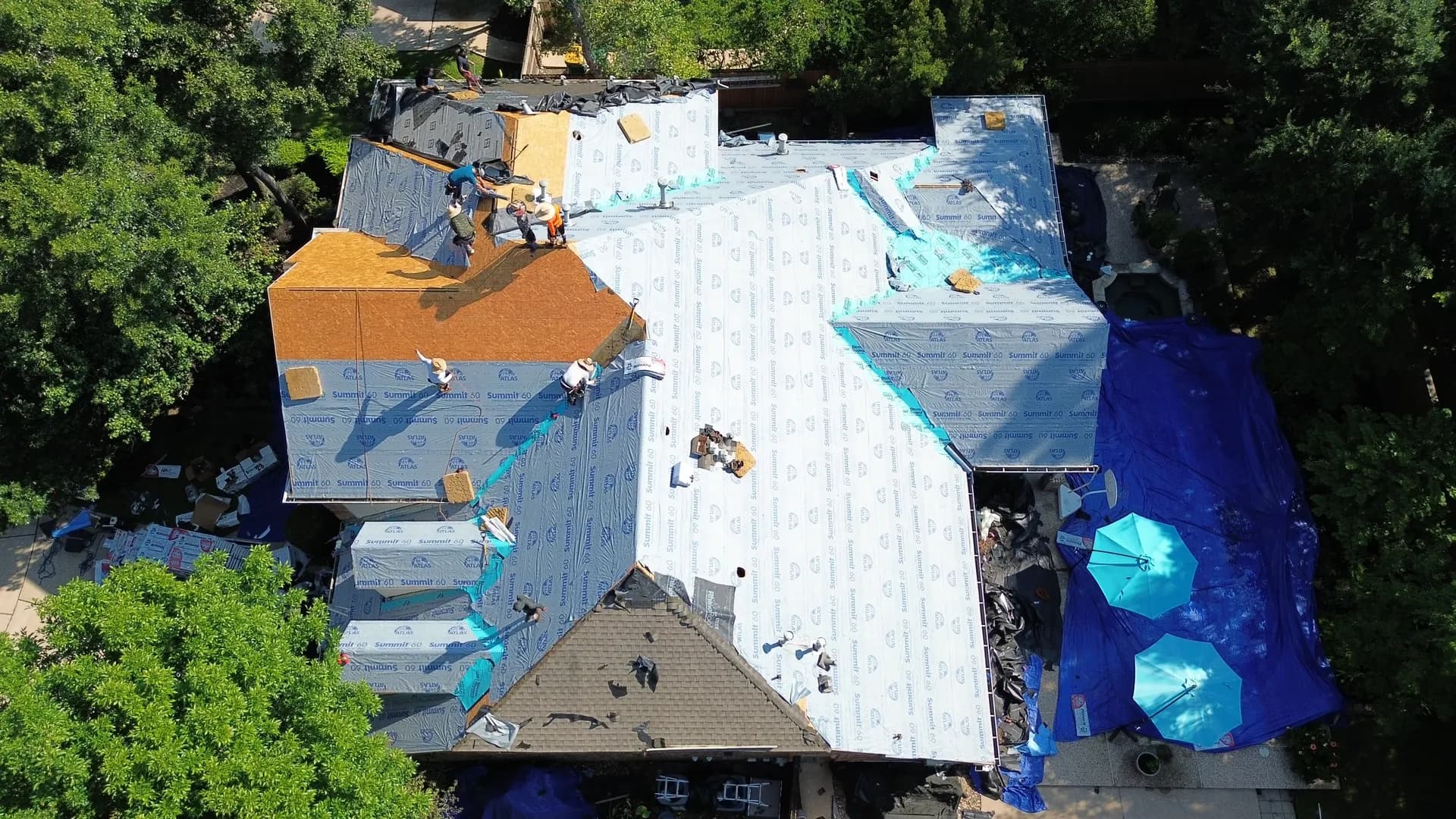
A standard roof deck has butt joints between sheets of plywood that are not sealed. Wind-driven rain finds those seams fast. IBHS testing found that sealing those seams, either with self-adhering tape over every joint or a fully adhered synthetic underlayment, can cut water intrusion into the home by up to 95 percent compared to an unsealed deck losing its shingle cover in the same storm.
Put a number on what that means. IBHS estimates that roughly one inch of rain falling on a fully exposed, unsealed deck can put the equivalent of nine bathtubs of water into a home before the roof is ever tarped or repaired. That's not damage from the wind itself. That's water damage that happens after the wind has already done its job, while everyone is still waiting for a crew to show up. A sealed deck buys time between when shingles come off and when a repair crew can get a tarp on the roof, which after a regional storm damage roof repair event, can be measured in days, not hours.
Enhanced Edge and Attachment: Why the Nails Matter
The second core requirement sounds almost too simple to matter, and that's exactly why it gets overlooked. FORTIFIED specifies ring-shank nails in a tighter spacing pattern than most building codes require, along with a wider metal drip edge and a fully adhered starter strip at the eaves and rakes.
Wind doesn't fail a roof evenly across its whole surface. It concentrates uplift force at the edges, corners, and ridge, the same way peeling a sticker starts at a corner rather than the middle. A smooth-shank nail in a standard pattern can back out or pull through the shingle under repeated wind loading at those pressure points. A ring-shank nail with tighter spacing resists that pull-through significantly better, because the barbed shank grips the deck instead of relying on friction alone.
None of this shows up on a finished roof from the ground. You can't look at a completed roof and tell whether the edge nailing pattern meets FORTIFIED spacing or standard code minimums. That's part of why the designation process exists.
How a Home Actually Gets the Designation
A homeowner can't self-certify a FORTIFIED roof, and a contractor can't issue the designation either, no matter how closely the work follows the standard. The process runs through an independent FORTIFIED Evaluator, someone trained and approved by IBHS, who documents the installation using IBHS's own evaluation platform.
Because most of what qualifies a roof (deck sealing, nail spacing, drip edge attachment) gets covered up the moment shingles go down, the evaluator generally needs to inspect and photograph the work in progress, not after the fact. That's a scheduling reality worth knowing before you start a project: if a FORTIFIED designation is something you want, the evaluator needs to be lined up before, not after, your roof replacement begins. The evaluator submits documentation to IBHS, and IBHS reviews it and issues, or denies, the designation.
The Insurance Angle, Framed Honestly
This is usually the first question homeowners ask, and it's also the one that's easiest to overstate. Some insurers operating in Texas do offer premium discounts or credits for wind-mitigation improvements that align with FORTIFIED, since the underlying features (a sealed deck, reinforced edges, opening protection) directly reduce the kind of storm damage that drives claims. But Texas doesn't have a single statewide mandated FORTIFIED discount the way a handful of Gulf and coastal states do.
What that means practically: whether a discount applies, and how much it's worth, depends on your specific insurer and policy. The honest answer is to call your agent and ask what a documented wind-mitigation designation would do to your premium before assuming a number either way. If you're weighing whether an insurance claim will even cover the roof work in the first place, that's a separate question worth reading about in our post on whether insurance will pay for your roof.
How FORTIFIED Relates to Ordinary Code Minimums
Building code sets a floor. It's the minimum a structure has to meet to be legally built, and it's written to apply broadly, not tuned to a specific region's worst-case wind or hail exposure. FORTIFIED was built from wind-tunnel and full-scale testing aimed specifically at what separates a roof that survives a severe storm from one that doesn't, and in most jurisdictions its requirements sit meaningfully above code minimums, not just a notch higher.
That gap is exactly why the standard exists as a voluntary, add-on program instead of getting folded into code everywhere. Meeting code means a roof is legal to build. Meeting FORTIFIED means someone tested, documented, and independently verified that the roof is built to a higher wind and water-intrusion standard than the law requires.
Ask Your Roofer About Building to These Standards
You don't need to pursue a formal FORTIFIED designation to benefit from understanding what it requires. A sealed deck, proper edge nailing, and a wind-rated roof covering are things any competent roofing contractor can build toward on a standard re-roof, designation or not. If you're planning a replacement and want to talk through what wind-resistant construction practices would look like on your specific roof, including whether pursuing a formal FORTIFIED evaluation makes sense for your situation, we're happy to walk through the options with you.
Seth WeHunt
Owner, ROYH Build Co
Get Your Roofing Quote
Serving The Woodlands, Magnolia, and greater Houston, ROYH Build Co offers free inspections and straightforward estimates.