
How Often Should Gutters Be Cleaned in Houston's Humid Climate?
By Seth WeHunt · · 6 min read
How often should gutters be cleaned in Houston? For most homes in the area, the honest answer is at least twice a year, and often three or four times if the property has real tree cover. That's more frequent than the standard twice-a-year advice you'll find in national maintenance guides, and there's a reason for it. Houston's mix of heavy humidity, dense vegetation, and a storm season that runs half the calendar year puts more organic material into a gutter system than drier, less wooded parts of the country ever see.
Why Gulf Coast Humidity Changes the Cleaning Math
Humidity does more than make August miserable. Year-round moisture and warmth support the kind of vegetation growth Houston yards are known for, live oaks, loblolly pines, crape myrtles, magnolias, all shedding something onto the roof at different points across the year. Because leaves, tassels, and needles drop almost continuously here rather than in one tidy autumn window, gutters accumulate organic debris across most of the year instead of just a few weeks in October.
That debris doesn't just sit there and wait. Mixed with Houston humidity, it breaks down into a damp, compost-like layer that holds moisture against the fascia board and roof edge. Give it a few weeks of July heat and you get mildew growth, a musty smell near the roofline, and standing water that never fully evaporates between rain events.
Standing water is also exactly what mosquitoes need to breed, and clogged residential gutters are a recurring source that Harris County mosquito control teams check during peak season. So a gutter cleaning schedule in Houston isn't only about protecting the roof and fascia. It's a moisture and pest control decision too, whether homeowners think of it that way or not.
Houston's Real Debris Calendar
Most gutter advice online is written for a single autumn leaf drop. That's not how it works here. Houston's debris calendar has four distinct waves, and each one puts a different kind of material into the gutter channel.
Spring (March through May)
Oak trees release pollen-heavy tassels, or catkins, by the pound before they leaf out. This coats gutters in a sticky yellow-green film that packs down into a mat once it gets wet. Spring also brings the season's first heavy thunderstorm cycles, which test whether a gutter can move that pollen load fast enough to avoid overflowing onto the siding below.
Summer (June through September)
Hurricane season overlaps almost the entire Houston summer. Even in a year without a named storm making landfall, the routine pattern of intense, short-duration afternoon downpours moves a huge volume of water through gutters in a narrow window of time. Any debris already sitting in the channel turns a heavy summer storm into a waterfall over the fascia instead of controlled drainage into the downspout.
Fall (October through November)
Loblolly and other pines common across the Houston area shed needles steadily through fall. Needles are notoriously good at threading through gutter guard mesh and packing tight into downspout openings in a way broad leaves simply don't.
Winter (December through February)
Cold fronts bring wind-driven rain, and any leaves that held on through a mild Houston fall tend to let go all at once when the first hard front rolls through. It's usually a smaller debris load than spring or fall, but it's still worth a check before the wettest stretch of winter sets in.
How Often to Clean Gutters, By Lot Type
Every homeowner wants a single magic number, and that's fair. The honest answer is that lot type matters more than the calendar does. Two houses on the same street can need completely different schedules if one backs up to a wooded lot and the other sits on an open corner with a single crape myrtle out front.
As a starting point for Houston-area properties:
- Open lots with little to no overhanging tree canopy generally do fine with a cleaning twice a year, once in late spring after the oak tassels have finished and once in late fall after the last leaves drop.
- Moderate tree coverage, a handful of mature trees within reach of the roofline, usually needs three cleanings a year to stay ahead of the spring pollen wave and the fall needle drop.
- Heavy canopy lots, where oaks or pines overhang the roof directly, often need quarterly cleaning, and sometimes closer to every eight weeks during peak pollen and needle season.
These are starting points, not rules carved in stone. A quick look at the actual roofline tells you more than any generic schedule can.
Signs Your Gutters Are Overdue
The calendar is a guideline. These are the signs that override it:
- Water spilling over the front edge of the gutter during a normal rain, not just during a downpour.
- Visible plant growth sprouting out of the gutter itself. It sounds unlikely, but with enough organic buildup and Houston rain, it happens more than people expect.
- Dark streaking or mildew stains running down the siding below the gutter line.
- Sagging sections where the gutter has pulled away from the fascia under the weight of wet, packed debris.
- Standing water or noticeable mosquito activity near the downspout outlets even after the yard has otherwise dried out.
Any one of these is worth a look. Two or more, and the gutters are past due.
How Gutter Guards Change the Math
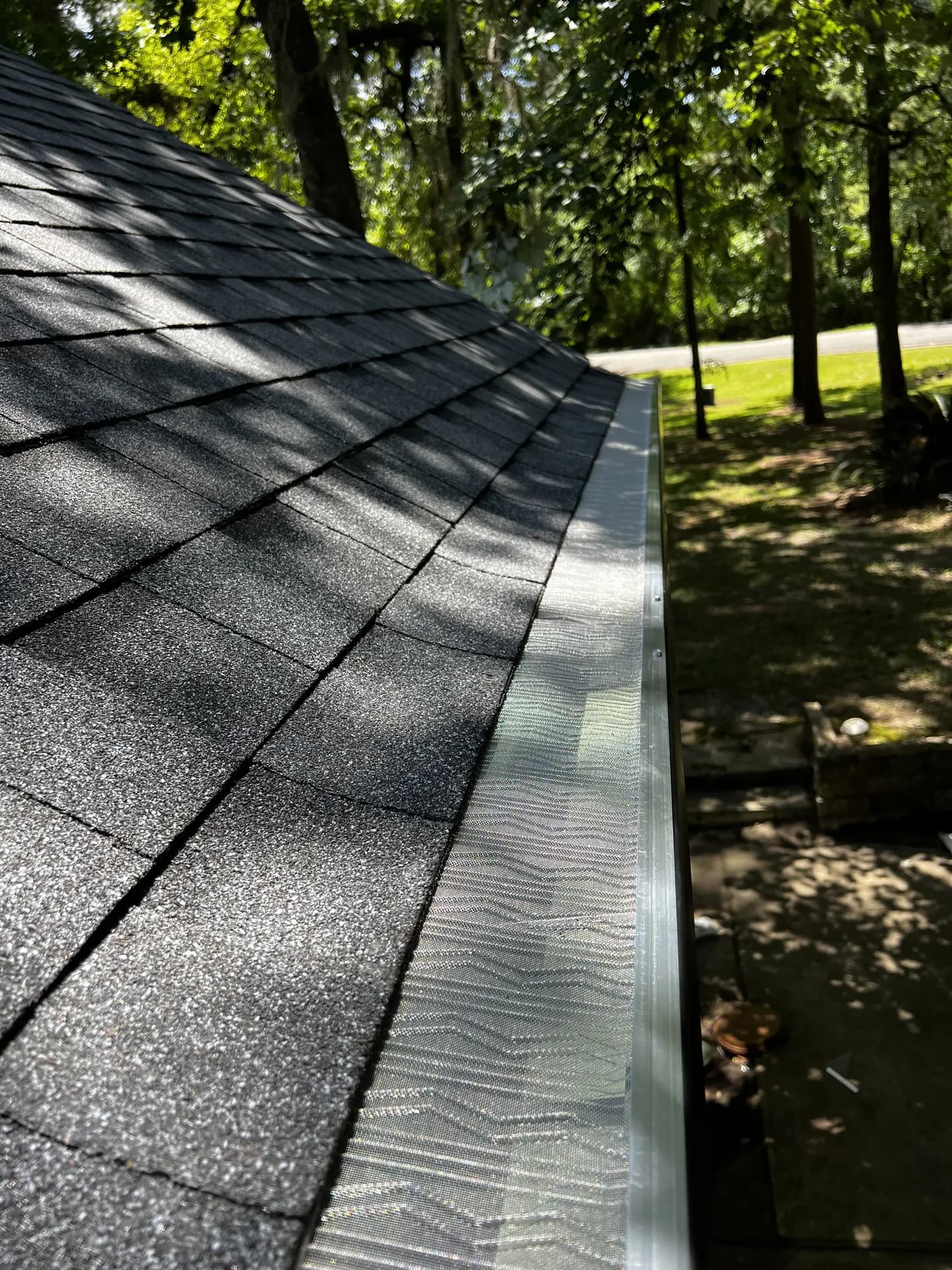
Guards shift the schedule. They don't erase it. A quality mesh guard system, including the LeafBlaster systems we install, keeps out broad leaves and oak tassels effectively, which cuts down the spring and fall workload by a wide margin. Pine needles are the one debris type that gives most guard designs trouble, since they're narrow enough to work through fine mesh over time in a way flat leaves can't.
Practically, that means a guarded gutter on a lot with heavy pine coverage might drop from quarterly cleaning down to once a year rather than zero. A guarded system on a mostly-oak lot with no pines nearby can get much closer to a check-it-and-forget-it routine. If you're weighing whether guards are worth the upfront cost for your property, our breakdown of what a gutter guard actually does and whether it's worth it walks through the tradeoffs in more detail. For installation on an existing system, our gutter guard installation page covers what that looks like on a Houston-area roofline.
Getting a Schedule That Fits Your Property
A generic twice-a-year rule works fine somewhere with a short, mild autumn and not much else going on. It doesn't hold up against Houston's humidity, canopy, and storm pattern the way it would in a drier climate. The better approach is matching the cleaning schedule to what's actually growing over the roofline and how the property drains during a heavy summer storm.
ROYH Build Co serves homeowners across the Houston area, including Houston, TX and the surrounding Harris County communities, along with The Woodlands and Magnolia. If gutters have been ignored for a season or two, or it's just time for a professional look before hurricane season peaks, our gutter cleaning service can get ahead of it and flag anything, sagging sections, loose fasteners, early fascia damage, that's worth addressing before it turns into a bigger repair. Reach out and we'll work out a schedule that actually matches your lot instead of a one-size-fits-all calendar reminder.
Seth WeHunt
Owner, ROYH Build Co
Get Your Roofing Quote
Serving The Woodlands, Magnolia, and greater Houston, ROYH Build Co offers free inspections and straightforward estimates.